 FiberRemedy
Detergent & Machine Mechanics
How much HE laundry detergent should you use?
Two tablespoons is not a universal dose.
Before you start
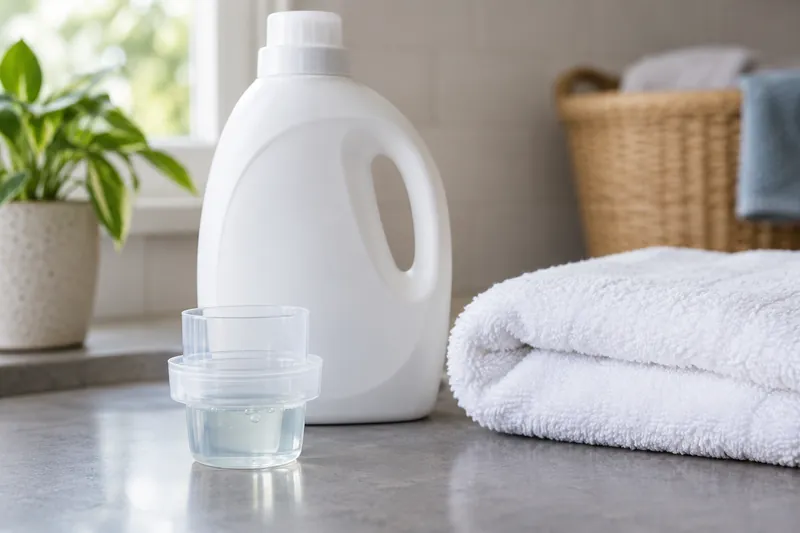
Two tablespoons is not a universal dose. A concentrated liquid, a powder and a single-dose packet are different products, and water hardness and soil level affect their instructions. Start with the exact product’s dose for your machine and load rather than converting a social-media rule into a fixed limit.
The Critical Micelle Concentration (CMC) Plateau: Why More Soap Does Not Clean More Dirt
The single most common mistake in residential laundry is filling a plastic detergent cap to the top—or pouring 80 to 120 mL (frac{1{3 to frac{1{2 cup) of concentrated liquid detergent into a High-Efficiency (HE) washing machine under the assumption that twice as much soap removes twice as much dirt.
In physical chemistry, surfactant cleaning power does not scale linearly with dose; instead, it follows a sharp step-function governed by the Critical Micelle Concentration (CMC).
What Happens Below, At, and Above the CMC
- Below the CMC (
0 to 0.15 g/Lactive surfactant): Individual surfactant monomers dissolve in water and migrate to air-water and fabric-water interfaces, progressively lowering water’s surface tension from72.8 mN/mdown tosim 30\–35 mN/m. Until the CMC is reached, there are no spherical micelles in solution to solubilize oil or grease. - At the Working Detergency Plateau (
2× to 5× CMC, orsim 0.4 to 1.0 g/Lactive surfactant): Once monomer saturation is reached, additional surfactant molecules self-assemble into spherical micelles (50\–100monomers per micelle) with hydrophobic hydrocarbon cores that engulf sebum, cooking oils, and particulate soot. Surface tension hits a flat floor (sim 30 mN/m) and cannot drop any lower. - Gross Over-Dosing (
>10× CMC): Pouring extra detergent once the wash liquor is already saturated with free micelles does not lower surface tension further and does not speed up stain removal. Instead, the excess micelles remain un-utilized in the tiny volume of wash water, waiting to overwhelm the rinse cycle and suffocate mechanical agitation.
Why Modern HE Machines Only Need 15 to 30 mL (1 to 2 Tablespoons)
To understand why 1 to 2 tablespoons (15–30 mL) of modern liquid HE detergent is mathematically sufficient for an entire 4 to 6 kg (9 to 13 lb) laundry load, compare the water-to-cloth ratio (liquor ratio) of a 1990s top-loader against a modern horizontal-axis HE front-loader:
| Washing Machine Architecture | Main Wash Water Volume | Liquor Ratio (Liters Water per kg Dry Cloth) | Active Surfactant Needed to Hit 0.8 g/L Plateau |
Exact Dose of 2X–3X Concentrated HE Liquid |
|---|---|---|---|---|
| Legacy Deep-Fill Top-Loader | 75\–110 Liters (20\–29 gal) |
18:1 to 25:1 |
60\–85 g surfactant |
90\–120 mL (6\–8 tbsp) |
Modern HE Front-Loader (Standard 4.5 kg Load) |
12\–16 Liters (3.2\–4.2 gal) |
2.8:1 to 3.5:1 |
10\–13 g surfactant |
15\–25 mL (1\–1.7 tbsp) |
Modern HE Heavily Soiled / Large 7 kg Load |
18\–22 Liters (4.8\–5.8 gal) |
3.0:1 |
15\–18 g surfactant |
30 mL (2 tbsp max) |
In a modern HE front-loader, nearly 70\\% of the water that enters the drum is immediately absorbed inside the wet clothes, leaving only 4 to 6 liters of free liquid sump water sloshing at the bottom of the drum! When you pour 15 to 25 mL (1 to 1.7 tablespoons) of concentrated HE liquid detergent (which contains 35\\% to 55\\% active surfactants by weight) into 14 liters of total water, you immediately achieve an active surfactant concentration of 0.6 to 1.0 g/L—right in the middle of the optimal micellar cleaning plateau.
Sinner’s Circle: How Over-Sudsing Destroys Mechanical Cleaning Power
In 1959, Dr. Herbert Sinner (head of detergent research at Henkel) formulated Sinner’s Circle, the fundamental law of laundry engineering. Sinner proved that every wash process is governed by four interdependent energies whose shares must sum to 100\\%:
Total Cleaning Work = Chemistry + Mechanical Action + Temperature + Time
In a horizontal-axis front-loading washing machine, Mechanical Action provides up to 40\\% of total soil removal through gravitational lift-and-drop. As the drum rotates at 45 to 55 RPM, internal paddles (lifters) carry wet garments to the 10 o'clock or 11 o'clock position, where gravity drops them back down onto the bottom of the steel drum. That impact compresses the wet fabric pores and forces enzymatic detergent solution at high velocity right through the yarn interstices (hydrodynamic flushing).
The Foam-Cushioning Failure Mode
When you overdose detergent (>30 mL) in a low-water HE drum, air whipped into the concentrated surfactant liquor generates a thick, viscous three-dimensional foam mattress filling the center of the drum:
- Loss of Drop Impact: Instead of falling sharply through air and slapping against the bottom of the drum, lifted clothes land softly on a compressible cushion of suds. Mechanical impact force drops by
35\\% to 50\\%, leaving particulate dirt, mud, and collar sebum undisturbed inside the weave. - Suds-Lock & Spin Interruption: Modern HE washers monitor drain-pump current and drum tachometer resistance. When thick foam enters the drain pump (cavitation / suds-lock), the pump cannot evacuate water, forcing the machine’s computer to abort high-speed intermediate spins (
800 RPM) and extend the cycle by 30 to 45 minutes while injecting emergency cold-water defoaming rinses.
The Rinse-Dilution Bottleneck and How to Dose Precisely
Unlike old top-loaders that flooded clothes with 80 liters of deep rinse water, an HE washer performs two spray/tumble rinses using only 15 to 20 liters of cold water each.
If you dose 90 mL of detergent (4× the needed amount), mathematical dilution curves show that after two standard HE rinses, 3 to 6 grams of un-rinsed surfactant and optical brighteners remain permanently dried onto your clothing. Against sweaty skin, residual anionic surfactants disrupt the stratum corneum lipid barrier (triggering contact dermatitis), while inside the washing machine, un-rinsed surfactant coats the outer aluminum spider bracket and rubber bellows boot with a nutrient-rich slime for black Aspergillus mold and Moraxella bacteria.
Your Precision Dosing Reference Chart
Throw away the oversized plastic cap that came on the detergent bottle (or ignore the vague “Line 1 / Line 2 / Line 3” markings, which often measure 45 to 90 mL) and keep a dedicated stainless-steel 15 mL (1 US tablespoon) measuring spoon or shot glass on your laundry shelf:
- Small / Lightly Soiled Load (
2–3 kg):15 mL(1 level tablespoon) of liquid HE detergent. - Normal Daily Load (
4–5 kg):20 to 25 mL(1.5 tablespoons) of liquid HE detergent (or 1 single laundry pod). - Heavy / Large Family Load (
6–8 kg):30 mL(2 level tablespoons) maximum. If the load is heavily stained, boost cleaning power by adding15 gTrisodium Citrate (for water hardness) or30 gSodium Percarbonate (for oxidative stain cleavage)—never by doubling the surfactant dose!
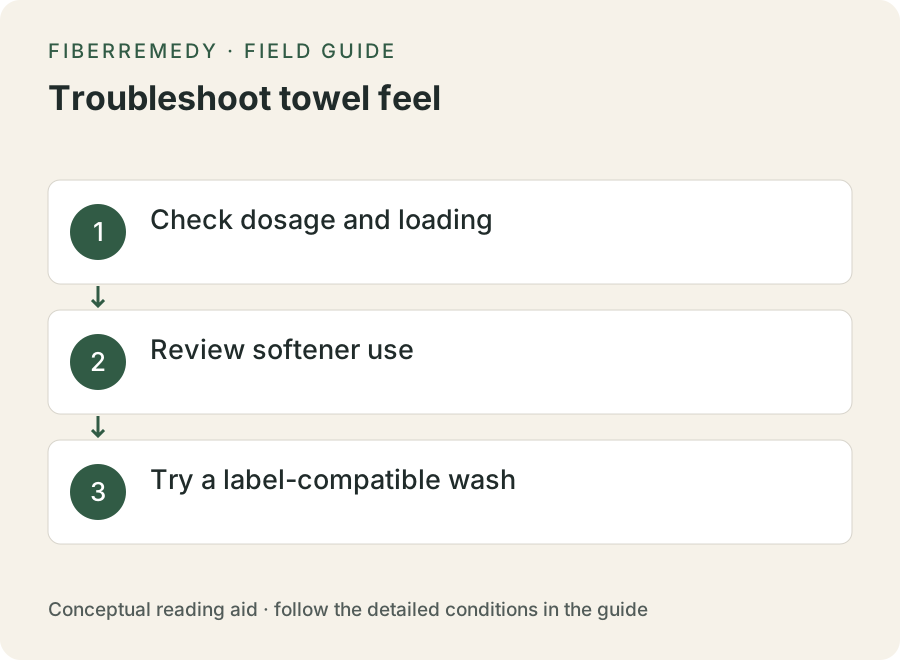
See how un-rinsed surfactant combines with hard-water minerals in Hard-Water Calcium and Magnesium Scum: Chelation with Sodium Citrate and Borax, learn how to strip accumulated detergent and quat films in Towel Strip-Washing Chemistry, and check drum mechanical action bars in our ISO 3758 & ASTM D5489 Garment Care Symbol Decoder.
Practical check: what to observe
Use a marked measuring cap and note the load size and soil type. Assess cleaning and rinsing together over comparable loads. If clothing still carries body oil, simply reducing the dose further can make the problem worse; return to the product guidance.
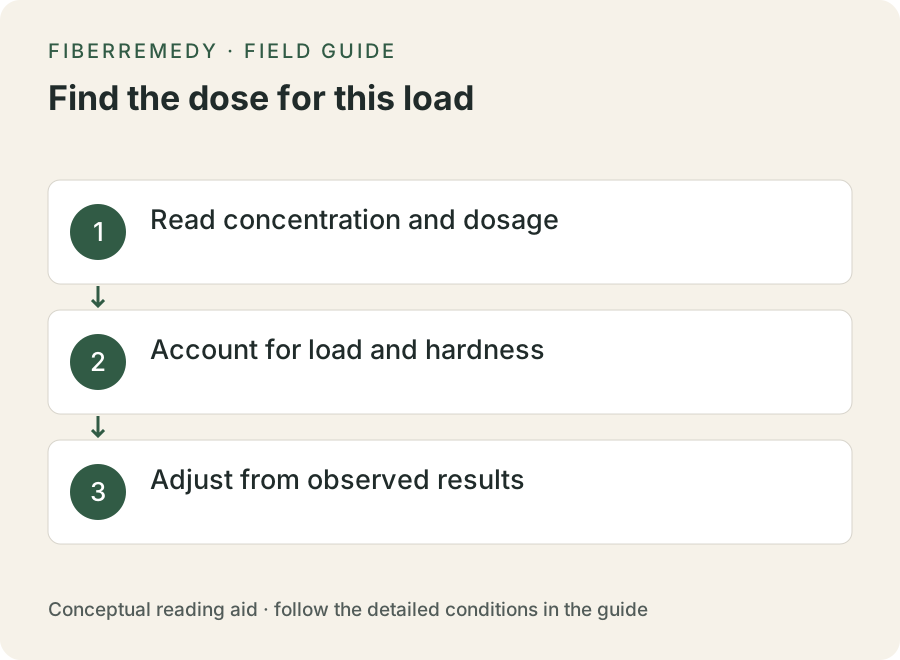
- Read concentration and dosage
- Account for load and hardness
- Adjust from observed results
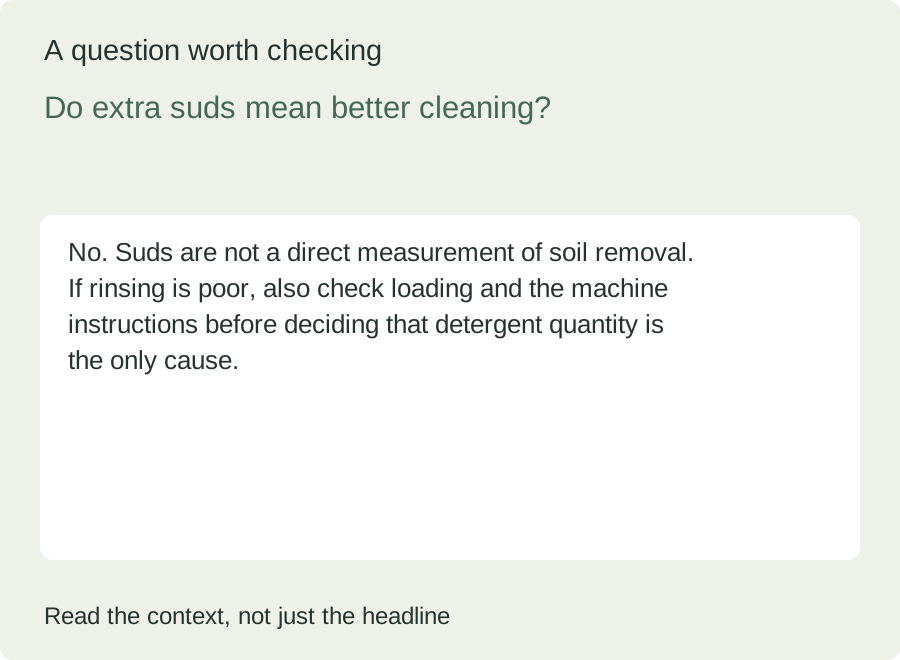
Do extra suds mean better cleaning?
No. Suds are not a direct measurement of soil removal. If rinsing is poor, also check loading and the machine instructions before deciding that detergent quantity is the only cause.
For more context, see the topic FAQ and glossary. A reference value or example should be read with its units, assumptions and product-specific conditions.
Sources and scope
The references below were supplied with the original manuscript. A reference is not evidence that every numerical claim has been independently checked. See the source library and our verification status.
- Sinner, H. (1960) — Über das Waschen mit Haushaltwaschmaschinen: Sinner's Circle of Time, Temperature, Chemistry, and Mechanics
- Rosen, M. J. & Kunjappu, J. T. (2012) — Surfactants and Interfacial Phenomena: Critical Micelle Concentration and Detergency (Wiley)
- Stamminger, R. (2011) — Modelling Resource Efficiency in Domestic Laundry: Water Volume, Mechanical Action, and Rinsing Efficiency
Put the explanation to work
Continue reading
Spot a questionable claim or a calculation issue? Read our correction process and contact information. Examples and illustrations are educational; they do not establish product suitability or a laboratory result.