 FiberRemedy
Explainers
Two laundry books, two reading styles: choose for your wardrobe
Compare the scope of Laundry and Laundry Love, then build a reading plan around the clothes you actually own.

Before you start
Choose a laundry book according to whether you need a reference system or a more personal introduction to clothing care. The comparison here is based on publisher and author descriptions, not a cover-to-cover review or a test of every recommendation.
Start with your wardrobe’s difficult corner
A household with washable cotton basics has different questions from someone caring for lined jackets and wool knitwear. Before comparing books, identify the items you postpone washing. Is the uncertainty about a stain, a symbol, a drying method or finding enough time?
Your answer becomes a reading brief. A book that gives you a usable way to organize those decisions may be more valuable than one offering a long list of dramatic cleaning tricks.
What the official descriptions tell us
Cheryl Mendelson’s Laundry: The Home Comforts Book of Caring for Clothes and Linens is presented as a wide-ranging reference to caring for clothing and household textiles, including stains and storage.
Patric Richardson’s Laundry Love, written with Karin B. Miller, combines practical advice with personal stories. Richardson’s biography describes his apparel and textiles studies, retail background and Laundry Camp teaching. That background is different from independent laboratory testing.
| What you want from reading | Useful format to look for | Question for a sample chapter |
|---|---|---|
| An answer during laundry day | Reference sections and a clear index | Can I find my material or problem quickly? |
| A more approachable routine | Examples and personal narrative | Does this help me plan a task I avoid? |
| Care for an unusual garment | Explicit conditions and exceptions | Does the advice address its construction? |
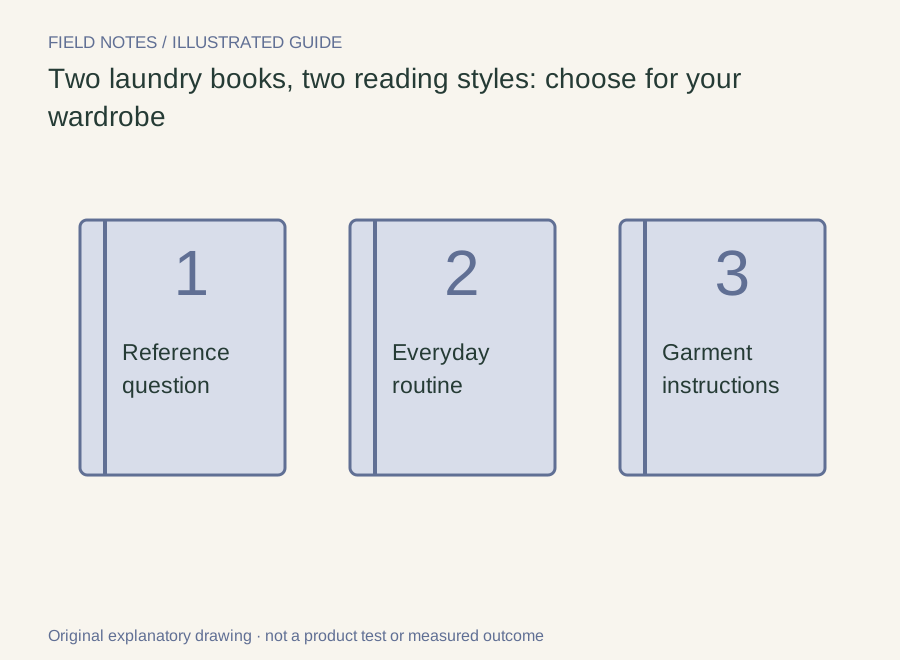
Build a wardrobe question sheet
Choose one easy-care item, one delicate item and one item with a recurring stain. Copy their care instructions into a notebook and photograph the labels for your own reference. Leave space for detergent restrictions, drying arrangements and unresolved questions.
Read with this sheet beside you. Record a proposed action separately from a confirmed instruction. You might write “investigate whether this garment permits hand washing,” rather than changing the care method because another person washed a superficially similar item successfully.
Give memorable advice a conditions check
An engaging author can make a routine feel manageable. The practical advice still needs to fit the item. GINETEX explains that care labels address permitted treatment of the complete textile article, including features such as color and accessories.
Use that as a reminder to look beyond fiber percentage. The same fiber can appear in garments with different construction and care needs. Our care-label reading guide helps organize the check without relying on memory.
Turn reading into one small improvement
A useful first outcome could be a dedicated drying space, clearer product measurements or a separate place for items needing special attention. Choose something you can repeat rather than replacing your entire routine at once.
For a measuring problem, use the detergent dose calculator with the actual product’s directions. For a crowded laundry day, start with the drying-first plan. A book becomes valuable when it helps answer a real question in your own home.
Practical check: what to observe
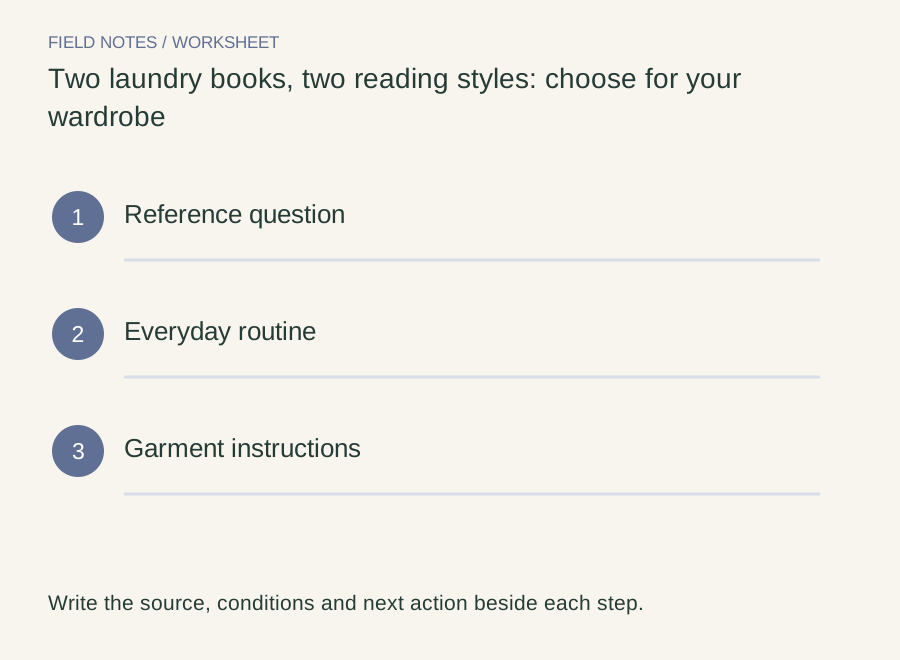
Pick three real garments and write down the questions their care labels leave you with. Use those questions to evaluate a library copy or authorized sample before deciding which book earns shelf space.
- Reference question
- Everyday routine
- Garment instructions
Can a book overrule the instructions on a particular garment?
A general recommendation does not establish compatibility with every fabric, dye, trim or construction. Use the garment and product instructions to check the proposed treatment, especially for an item you cannot readily replace.
For more context, see the topic FAQ and glossary. A reference value or example should be read with its units, assumptions and product-specific conditions.
Sources and scope
The reading below provides context for the relevant care or brewing principles. The article’s scenarios and decision questions are original editorial explanations, not independent product tests. Read the editorial policy for sourcing, AI assistance and corrections.
- Cheryl Mendelson — Laundry: The Home Comforts Book of Caring for Clothes and Linens
Publisher description used for reading selection, not endorsement of every treatment in the book.
- Patric Richardson with Karin B. Miller — Laundry Love
Author’s book description; personal advice remains subject to garment and product compatibility.
- Patric Richardson — Author and practitioner biography
First-person professional biography, not an independent validation of treatment performance.
- GINETEX — Care Labelling
Explains the scope of care instructions. Official symbol artwork is not reproduced here.
Put the explanation to work
Continue reading
Spot a questionable claim or a calculation issue? Read our correction process and contact information. Examples and illustrations are educational; they do not establish product suitability or a laboratory result.