 FiberRemedy
Explainers
What is in your laundry cupboard? Read the labels before buying more
Audit detergent and stain-removal products by fabric compatibility, dose and intended use, with an enzyme-label reference.
Before you start
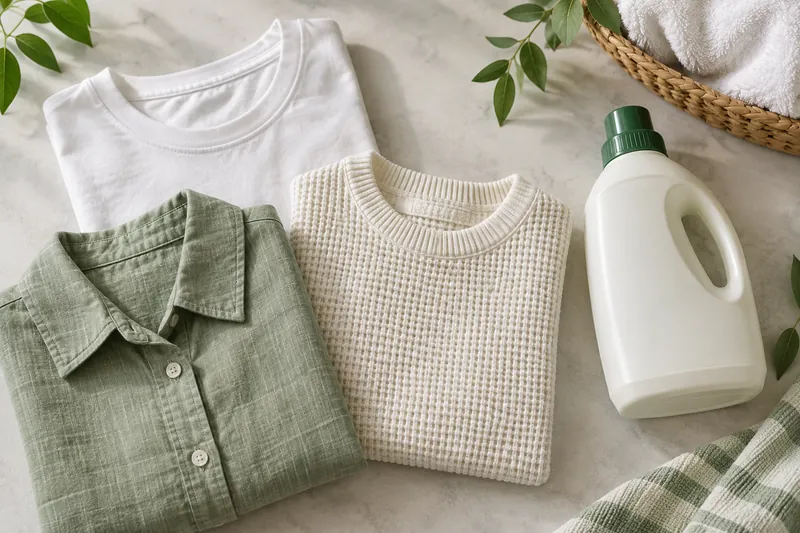
Make an inventory of what each product is for before buying another cleaner. Ingredient names can explain a function, but they do not establish that a whole formulation is suitable for a particular garment. Start with intended use, restrictions and dose.
Audit by job, not bottle count
A crowded cupboard can contain several products for the same task while leaving one recurring problem unresolved. List your actual jobs first: ordinary washable clothes, items needing a specific care product, and occasional stains. Then match the products you own to those jobs.
Do not decant unidentified leftovers into a common container. A usable inventory depends on retaining product identity and instructions.
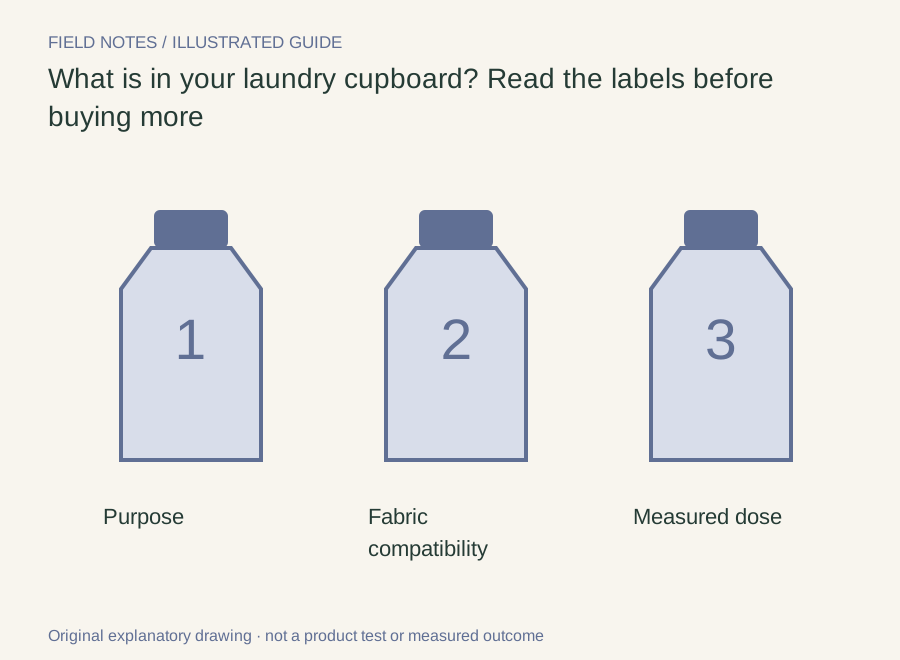
Make a label table
| Product | Intended job | Restrictions | Dose source |
|---|---|---|---|
| Your everyday detergent | Copy the stated use | Copy fabric or machine exclusions | Label directions for the relevant load |
| A specialist fabric product | Note the named materials | Note any incompatible treatments | Its own measuring guide |
| A stain treatment | Note the intended soils | Check fabric and color limitations | Its application directions |
Leave an unknown field marked unknown. An attractive package or a recommendation from a friend cannot fill in missing product instructions.
What enzyme names can tell you
The ACI enzyme factsheet explains that different enzymes target different components of soil. Proteases act on protein-based material, amylases on starch, and lipases on fats. Cellulases can contribute to cotton fabric care and reduced redeposition of particulate soil.
These are ingredient functions, not a recipe for choosing a product solely by suffix. The formulation, concentration and intended application remain relevant. A product containing an enzyme is not automatically appropriate for every fiber or dye.
Connect the product to a real garment
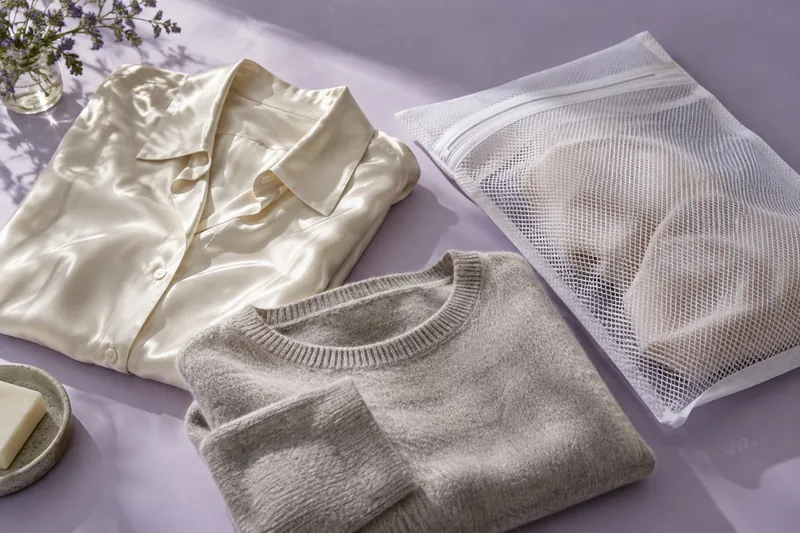
Take one recurring laundry problem and put the product label beside the garment label. Check that the proposed treatment fits both. GINETEX’s explanation of care labeling is useful when you need to understand treatment restrictions.
If the garment or product excludes the proposed use, do not treat a broad ingredient explanation as permission to ignore it. Our delicate-clothing guide helps with cases where construction or value makes experimentation a poor choice.
Separate a measurement problem from a product problem
Before deciding a product is ineffective, check whether you can reproduce its stated dose. A cap is a measuring tool only when you know which marking corresponds to the intended amount. Record the relevant load size and water condition if the product specifies them.
The detergent calculator can organize a label-based calculation. It cannot determine the correct dose from a product name or substitute one brand’s concentration for another’s.
Make a buy, keep or investigate list
“Keep” means you know its purpose and can use it according to instructions. “Investigate” means the compatibility, identity or directions are unclear. “Buy” should name a missing task, not just a desirable claim on a new package.
Review the table after a normal laundry cycle. Write down a result you can observe—remaining stain, visible residue or a handling difficulty—rather than assuming the cause. That gives you a better next question than adding another bottle to the shelf.
Practical check: what to observe
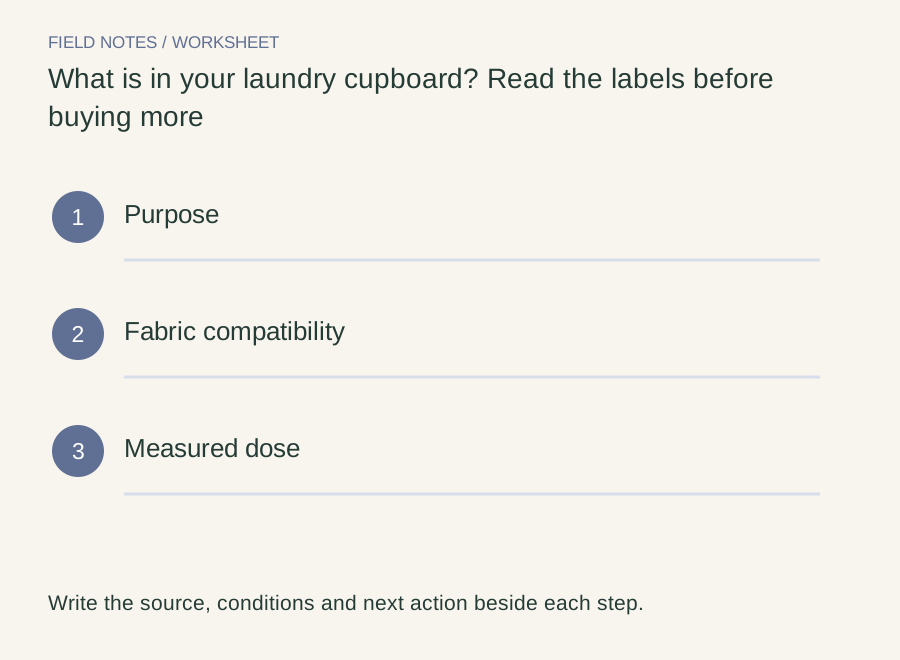
Choose three products you already own. Record each product’s purpose, fabric exclusions and measuring instructions. Keep products in their original labeled containers and do not combine them to create an untested formula.
- Purpose
- Fabric compatibility
- Measured dose
Does a longer enzyme list automatically make a detergent better?
No. An ingredient list does not reveal the whole formulation’s performance on your load. Compatibility, the kind of soil and correct use matter; an enzyme’s presence is not a universal quality score.
For more context, see the topic FAQ and glossary. A reference value or example should be read with its units, assumptions and product-specific conditions.
Sources and scope
The reading below provides context for the relevant care or brewing principles. The article’s scenarios and decision questions are original editorial explanations, not independent product tests. Read the editorial policy for sourcing, AI assistance and corrections.
- American Cleaning Institute — The Function of Enzymes in Cleaning
Ingredient functions are not a complete formulation-performance or compatibility test.
- American Cleaning Institute — Stain Removal Guide
General stain guidance; garment and treatment-product instructions still apply.
- GINETEX — Care Labelling
Explains the scope of care instructions. Official symbol artwork is not reproduced here.
Put the explanation to work
Continue reading
Spot a questionable claim or a calculation issue? Read our correction process and contact information. Examples and illustrations are educational; they do not establish product suitability or a laboratory result.