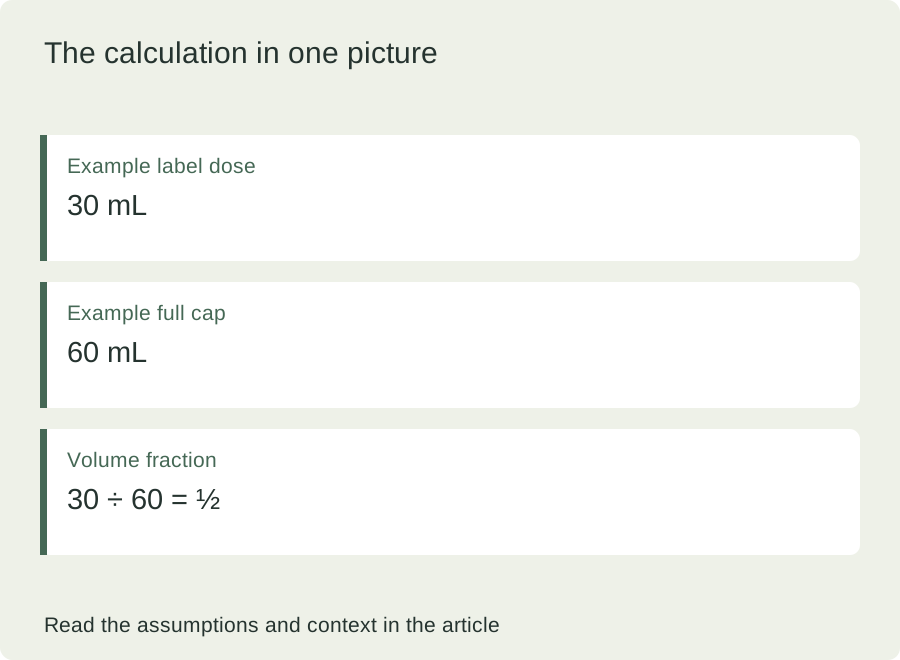
Put the label dose beside your laundry load. The measuring cup shows how a proportional calculation changes the amount.
See the calculation
Match the label to the load
Label dose
50 mL
Dry clothes
6 kg
Proportional amount
75 mL
Your calculation
1.5× the label reference load
How it works50 mL × (6 kg ÷ 4 kg) = 75 mL
What this assumes. Use this only when your detergent instructions permit proportional scaling. Many labels use dose bands or minimum doses. Water hardness, soil level, product concentration and machine instructions take priority. Never use this for bleach or other chemical additives.
Understand the calculation
Proportional dose = label dose × (your dry laundry weight ÷ the label’s reference load). The picture shows a ratio, not a calibrated measuring cap.
Measure before you calculate
Use this only when your detergent instructions permit proportional scaling. Many labels use dose bands or minimum doses. Water hardness, soil level, product concentration and machine instructions take priority. Never use this for bleach or other chemical additives.
Change one value at a time to see its effect. Example buttons fill in a complete scenario, and Reset example restores the starting values. No input is sent to a server.
AI-generated scene illustration. It does not document a test. About our images
May we use Google Analytics to understand which pages are useful? It loads only if you allow it. Your choice does not affect access to articles or calculators. How analytics works
 FiberRemedy