 FiberRemedy
Detergent & Machine Mechanics
Towel buildup: when a normal wash is enough
A bath of dark water is not a measurement of how dirty a towel was.
Before you start
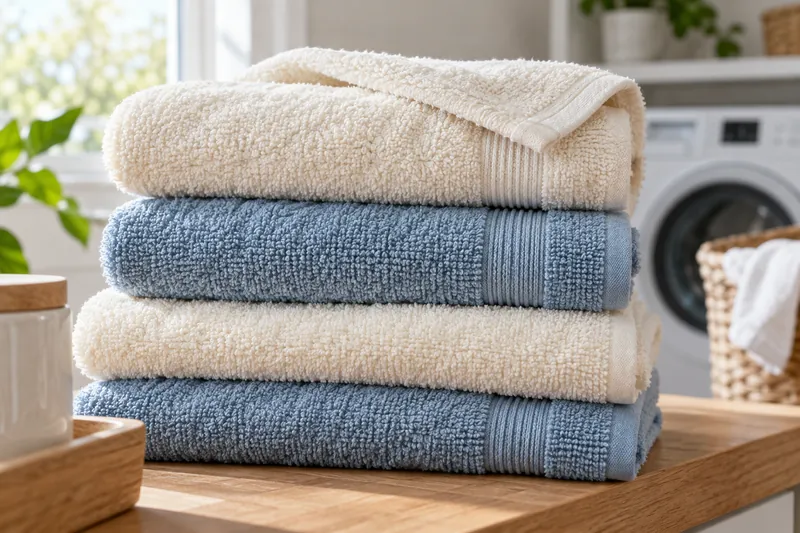
A bath of dark water is not a measurement of how dirty a towel was. It can contain dye, detergent, dissolved residue and material from the textile itself. Start by checking ordinary washing and drying habits rather than assuming that every stiff towel needs a prolonged stripping soak.
Why Cotton Terry Towels Stop Absorbing Water and Smell Sour
A new 100\% cotton terry bath towel owes its rapid water absorbency to capillary wicking and hydrogen bonding. Each cotton fiber consists of hydrophilic beta(1→ 4) cellulose chains packed with exposed hydroxyl (-OH) groups that form instantaneous hydrogen bonds with water molecules. Simultaneously, the thousands of uncut pile loops woven into terry cloth create microscopic inter-fiber capillaries that pull liquid water off your skin in less than 2 seconds (measured via AATCC Test Method 79, the standard water-drop wetting time test).
When a bath towel begins pushing water around your skin instead of absorbing it—or emits a sour, musty wet-dog odor the moment it gets damp after a shower—its cellulose surface is sealed beneath a three-layer composite film:
Layer 1: Cationic Fabric Softener Quats (The Hydrophobic Wax Coat)
Liquid fabric softeners and tumble-dryer sheets do not soften cotton mechanically; they lubricate fibers chemically using cationic surfactants called quaternary ammonium compounds (quats)—specifically dihydrogenated tallow dimethyl ammonium chloride (DHTDMAC) or modern biodegradable triethanolamine esterquats.
Because wet cotton cellulose carries a negative surface charge, positively charged quat headgroups (R₂N⁺(CH₃)₂) bind electrostatically to the exterior of the cotton loop during the final rinse. Once bound, their two long C16–C18 saturated fatty alkyl chains point outward into the air like microscopic bristles of paraffin wax. While this waxy monolayer reduces fiber-to-fiber friction (making the towel feel fluffy to your fingers), it turns the hydrophilic cellulose surface hydrophobic. Laboratory AATCC TM79 drop tests demonstrate that just 5 consecutive wash cycles with standard liquid fabric softener increase cotton wetting time from <1.5 seconds to >25 seconds, reducing total rate of water uptake by 50\% to 65\%.
Layer 2: Un-Rinsed Anionic Detergent + Hard-Water Lime Soap
When household washers are dosed with 2 to 3 times the necessary volume of liquid HE detergent, the machine’s low-volume cold rinse cannot flush all micelles out of thick 500–700 GSM cotton terry loops. When hard water (Ca^{2+, Mg^{2+) contacts this trapped surfactant, insoluble calcium-surfactant curd precipitates inside the core of the yarn. Worse still, if you use both excess anionic detergent and cationic fabric softener, the negative surfactant anions and positive quat cations react directly on the fabric to form a sticky, water-insoluble anionic-cationic coacervate sludge.
Layer 3: Exfoliated Keratin, Sebum, and Moraxella osloensis Biofilm
Every time you dry off after a shower, bath towels scrape thousands of dead corneocytes (skin cells) and residual skin lipids onto the damp terry pile. When trapped inside the waxy quat-and-lime-soap matrix and washed in cool 30 °C cycles without oxygen bleach, skin lipids feed resilient gram-negative bacteria—principally Moraxella osloensis and Micrococcus luteus. These bacteria excrete sticky extracellular polymeric substances (biofilm) and metabolize branched-chain fatty acids into 4-methyl-3-hexenoic acid (4M3H), the exact volatile compound responsible for the pungent “sour locker-room towel” smell that re-activates the instant moisture hits the towel.
Debunking the Viral Bathtub “Laundry Stripping” Trend
On social media, “laundry stripping” typically involves filling a bathtub with scalding hot water and soaking colored towels for 4 to 6 hours in a concentrated mixture of Borax, washing soda (Na₂CO₃), and a generous scoop of powdered laundry detergent. Proponents point to the murky brown or gray bathtub water as proof of “years of trapped filth.”
From a textile chemistry standpoint, viral bathtub stripping has three major flaws:
- The Murky Brown Water Is Mostly Hydrolyzed Dye: Immersing colored cotton towels in stagnant
pH 11.2sodium carbonate water at60 °Cfor 5 hours cleaves the covalent ester bonds linking reactive dyes to cellulose. When blue, green, gray, and beige dye chromophores bleed into the same tub, subtractive color mixing turns the water muddy brown—even with brand-new, unworn towels! - Stagnant Cooling Precipitates Soil Back Onto the Pile: Without mechanical drum rotation or continuous rinsing, as the bathtub water cools from
60 °Cdown to room temperature (22 °C) over 5 hours, dissolved calcium carbonate (CaCO₃from the washing soda) and emulsified waxes re-precipitate uniformly across the horizontal towel surfaces. - Zero Acid Descaling Phase: An all-alkaline soak cannot dissolve inorganic calcium/magnesium mineral crusts or strip cationic esterquats that require low-pH protonation or competitive micellar solubilization.
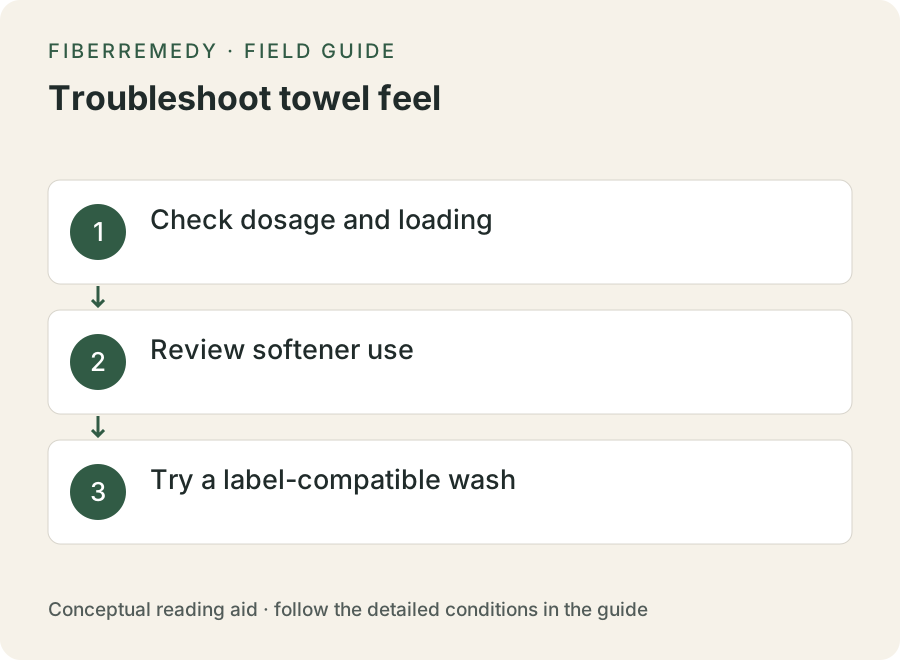
The Two-Stage Scientific Towel Restoration Protocol
Instead of soaking towels in a stagnant bathtub of pH 11.2 washing soda, textile chemists restore towel absorbency inside your washing machine using a two-stage Alkaline Chelation/Oxidation + Acid Descaling sequence. This protocol leverages continuous mechanical drum agitation and high-G spin extraction between stages.
Stage 1: Alkaline Chelation, Lipase Cleavage & Oxygen Sanitization
This first wash cycle dissolves oxidized sebum, breaks down bacterial biofilms, and sequesters the calcium bridging ions holding old detergent curd onto the yarn.
- Load size: Fill the drum no more than
60\%full (4–5bath towels maximum) so water can flush freely through the heavy terry weave. Separate whites from colors. - Temperature:
60 °C(140 °F) for white and colorfast vat-dyed towels;45–50 °C(115–120 °F) for dark reactive-dyed towels. - Chemistry added directly to the drum:
30 g(2 tablespoons) Trisodium Citrate Dihydrate (solubleCa^{2+/Mg^{2+chelator—replaces chalk-forming washing soda).30 g(2 tablespoons) Sodium Percarbonate (oxygen bleach; releasesH₂O₂to oxidize Moraxella biofilm and 4M3H odor molecules without weakening cotton cellulose).15 mL(1 tablespoon) of a Non-Ionic/Anionic Enzyme Detergent containing lipase and protease. Do not exceed1 tablespoon—remember that trapped surfactant already inside the towels will foam as soon as the citrate releases the calcium bridges!
- Cycle settings: Heavy Duty / Sanitize cycle with an Extra Rinse enabled and high spin (
1,000–1,200 RPM).
Stage 2: The Citric Acid Descaling & Quat-Release Cycle
Immediately after Stage 1 finishes spinning, leave the damp towels in the drum and run a second, shorter cycle with zero detergent and pure Citric Acid:
- Temperature: Warm (
40 °C / 104 °F). - Chemistry added directly to the drum:
30–45 g(2–3 tablespoons) of Anhydrous Citric Acid Powder (C₆H₈O₇). - How it works: Dropping the wash water pH to
3.2–3.8converts any remaining insoluble calcium/magnesium carbonate mineral crusts into soluble calcium citrate and carbon dioxide, hydrolyzes ester linkages in modern esterquat fabric softeners, and neutralizes alkaline carbonate pockets trapped deep inside the cotton lumen. - Verification (The AATCC TM79 Drop Test): Once the towels are tumble-dried (with zero dryer sheets, using only clean wool dryer balls for mechanical lofting), let a single drop of water fall from
1 cmonto the flat terry surface. A fully restored towel absorbs the droplet completely in under3 seconds.
For the coordination chemistry behind soluble calcium sequestration, read Hard-Water Calcium and Magnesium Scum: Chelation with Sodium Citrate and Borax, see why excess soap creates biofilm sludge in Home Machine Over-Dosing: Why 2 Tablespoons of HE Detergent Cleans Better, and decode towel wash temperature symbols in our ISO 3758 & ASTM D5489 Garment Care Symbol Decoder.
Practical check: what to observe
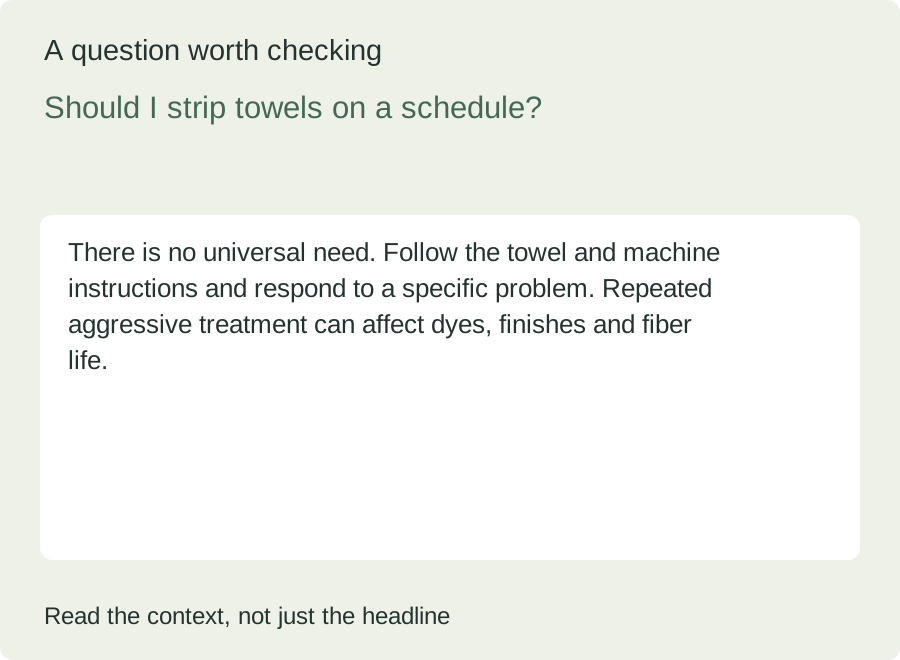
Compare similarly used towels after a normal correctly dosed wash and an adequate rinse. Note absorbency, odor after complete drying and fabric feel separately. Avoid combining multiple alkaline additives without a product-approved method; extra ingredients make results harder to interpret.
- Check dosage and loading
- Review softener use
- Try a label-compatible wash
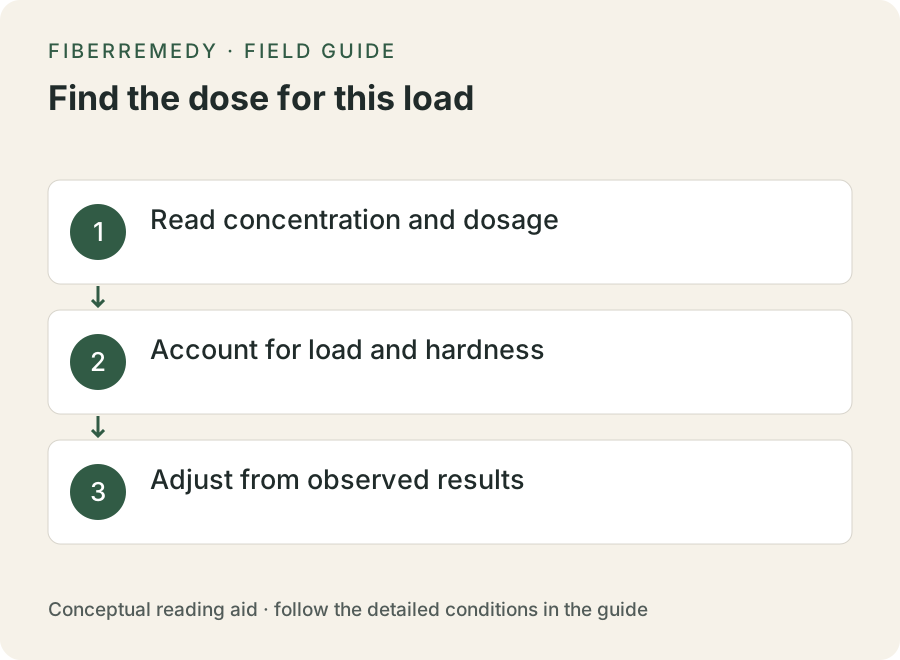
Should I strip towels on a schedule?
There is no universal need. Follow the towel and machine instructions and respond to a specific problem. Repeated aggressive treatment can affect dyes, finishes and fiber life.
For more context, see the topic FAQ and glossary. A reference value or example should be read with its units, assumptions and product-specific conditions.
Sources and scope
The references below were supplied with the original manuscript. A reference is not evidence that every numerical claim has been independently checked. See the source library and our verification status.
- AATCC Test Method 79 — Absorbency of Textiles (Wetting Time Drop Test)
- Crutzen, A. (2006) — Cationic Surfactants in Fabric Softeners: Esterquats and Rewetting Inhibition (Handbook of Detergents, Part D)
- Muiswinkel, G. C. J. et al. (2008) — Biofilm and Malodor Formation in Domestic Laundry Processes (Journal of Applied Microbiology)
Put the explanation to work
Continue reading
Spot a questionable claim or a calculation issue? Read our correction process and contact information. Examples and illustrations are educational; they do not establish product suitability or a laboratory result.