 FiberRemedy
In pictures
One chart shows what cost per wear can—and cannot—tell you
A price tag describes one purchase.
Before you start
A price tag describes one purchase. Cost per wear asks how that purchase relates to actual use, but it cannot decide whether an item suits your life.
Start with a transparent calculation
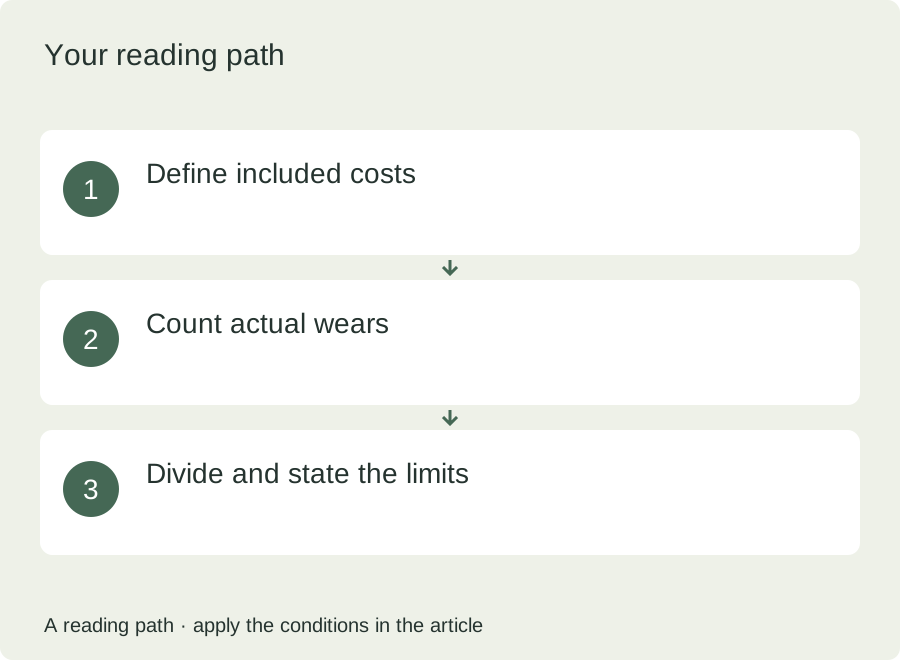
For a simple example, a garment costing $120 and worn 60 times has a purchase cost per wear of $2. Divide purchase price by actual wears. A $45 garment worn 15 times comes to $3 on the same narrow measure. These are hypothetical numbers, not a study of clothing quality.
Decide what belongs in the numerator
You can add attributable repair or care costs if you want a broader measure, but state what you counted. A $20 repair changes the first example to $140 divided by 60, or about $2.33 per wear at that point. Do not silently mix purchase-only figures with figures that include care.
Do not turn hoped-for use into evidence
Before buying, the number of future wears is a guess. A beautiful projection can make almost any purchase appear sensible. Use a realistic range instead of one flattering lifetime estimate. After ownership, a simple wear log can reveal whether the item fits your actual routine.
Show the uncertainty before buying
For a hypothetical $120 garment, 20 wears would mean $6 per wear, 60 wears $2 and 120 wears $1 on the purchase-only calculation. The price stays fixed while the estimated use changes dramatically. That makes future use the assumption worth examining. Look at comparable items you already own and how often you actually choose them. A special-occasion item may serve an important role despite a high cost per wear, while a daily item may justify its place through comfort and availability. The arithmetic should illuminate the decision, not pressure every garment into the same kind of use.
Keep comfort and suitability visible
An inexpensive-per-wear item can still be uncomfortable, difficult to care for or wrong for the occasion. The calculation is one lens, not a moral ranking of wardrobes. It is especially useful for comparing your own use patterns without pretending that a higher purchase price guarantees better value.
Practical check: what to observe
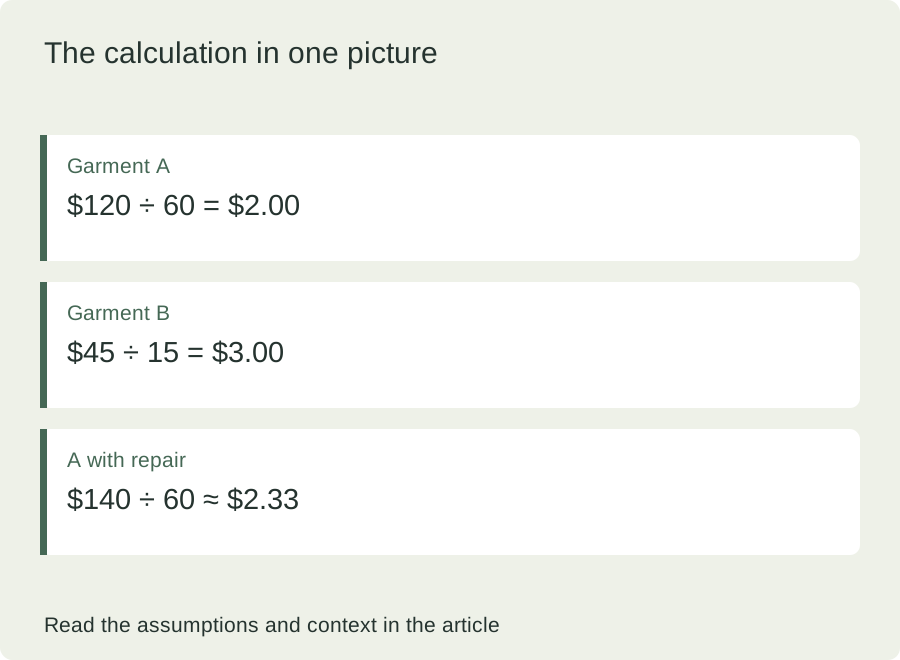
Work through the numbers using the stated units. The examples are illustrative; changing an input or an assumption can change what the result means.
- Define included costs
- Count actual wears
- Divide and state the limits
Does low cost per wear prove an item is sustainable?
No. This arithmetic does not measure material impacts, labor conditions, production, transport or disposal. Do not present it as a complete environmental assessment.
For more context, see the topic FAQ and glossary. A reference value or example should be read with its units, assumptions and product-specific conditions.
Sources and scope
The numerical examples use the arithmetic and assumptions shown in the article. They are hypothetical illustrations, not measurements of a tested product. Read the editorial policy for sourcing, AI assistance and corrections.
Put the explanation to work
Continue reading
Spot a questionable claim or a calculation issue? Read our correction process and contact information. Examples and illustrations are educational; they do not establish product suitability or a laboratory result.