 FiberRemedy
In pictures
Flat dry or hang dry? One diagram explains the difference
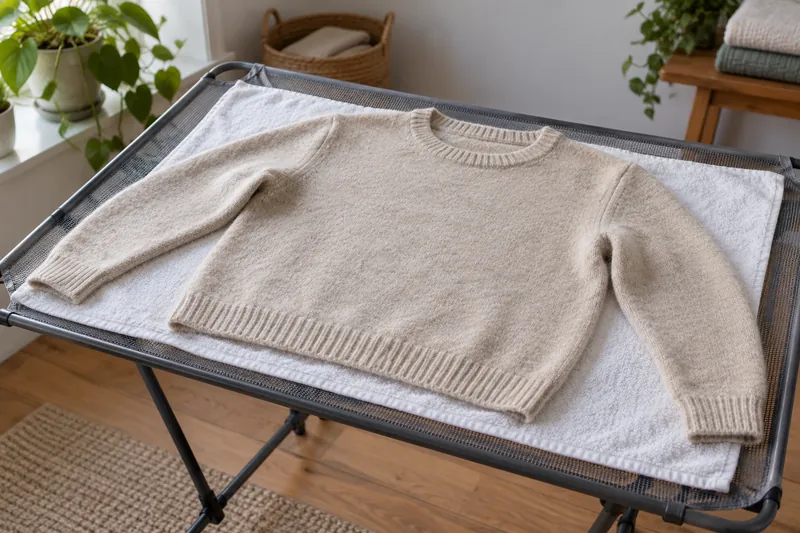
Drying instructions describe how an item is supported while it dries.
Before you start
Drying instructions describe how an item is supported while it dries. That support can matter as much as the place you put it.
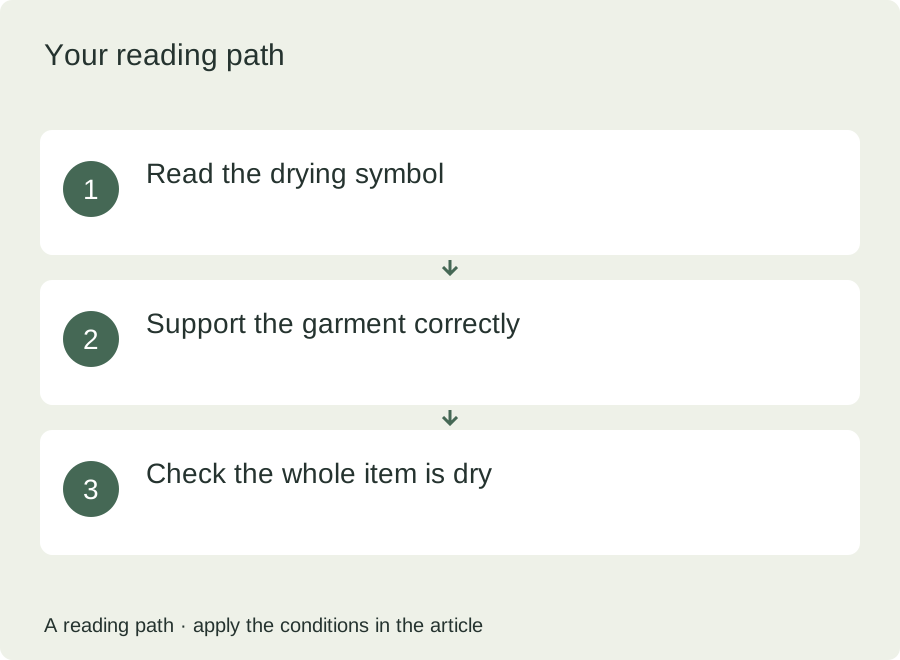
Read the drying instruction precisely
A garment may allow a particular method or prohibit another. Identify whether the instruction calls for flat drying, line drying, drip drying or another process. Do not translate every natural-drying symbol into put it on a hanger. Check any shade or reshaping directions too.
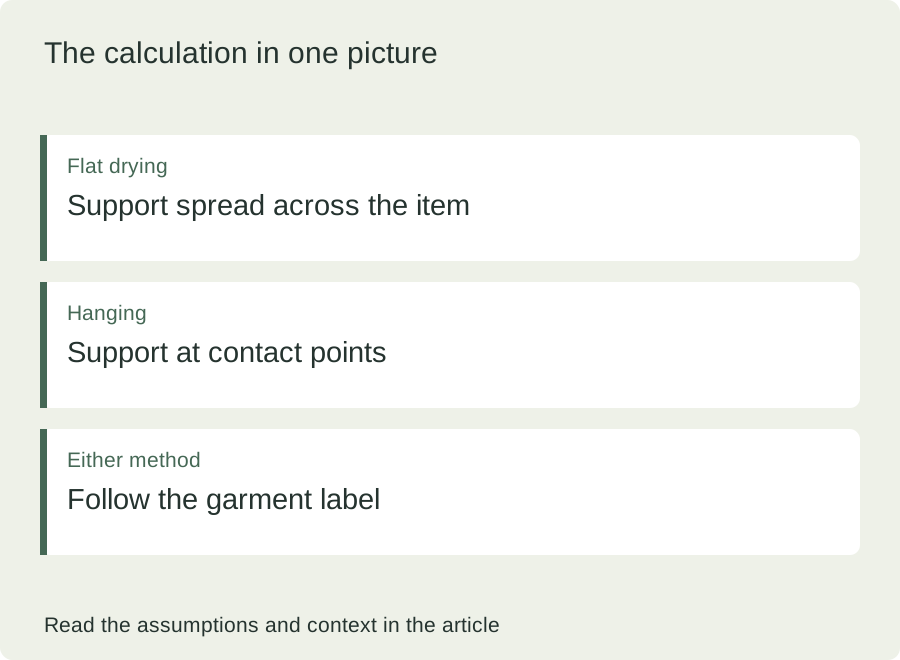
Understand what supports the weight
A flat arrangement distributes support across a suitable surface. Hanging concentrates support at the points touching a line or hanger. This simple difference helps explain why one method cannot casually replace the other for a wet knit. The illustration is conceptual; it does not predict how many centimeters a garment might stretch.
Prepare a suitable space
Follow the garment’s directions for removing excess water and arranging its shape. Use a clean surface and allow appropriate air circulation. A thick item folded over itself can remain damp in hidden areas. Protect nearby furniture from moisture and avoid adding direct heat unless the care instructions allow it.
Think through the space before wetting the item
A sweater that needs supported flat drying requires a suitable clean area at the moment it leaves the wash process. If that space is occupied, delaying the wash can be more practical than improvising on a narrow hanger. Plan where moisture can go, how air can circulate and how the garment can be checked without unnecessary stretching or repeated handling. The point of the diagram is support, not a promise about drying time. A thick knit and a light one can need different amounts of time under the same room conditions.
Check before storing
Feel and inspect thicker seams and folded areas, not just the exposed surface. Store the garment only when appropriately dry. If your home has little drying space, plan a smaller wash so each item can use the required method. A crowded rack is a scheduling issue as well as a care issue.
Practical check: what to observe
Work through the numbers using the stated units. The examples are illustrative; changing an input or an assumption can change what the result means.
- Read the drying symbol
- Support the garment correctly
- Check the whole item is dry
Can I speed up a flat-dry item on a radiator?
Do not assume direct heat is permitted. Follow the garment’s drying instructions and use an appropriate drying area.
For more context, see the topic FAQ and glossary. A reference value or example should be read with its units, assumptions and product-specific conditions.
Watch with context
How to Machine Wash a Wool Sweater
From Woolmark. An external demonstration to accompany the explanation. Follow the instructions for your own equipment or garment; a video is not evidence for every claim on this page.
Player requested. If the player remains blank or reports an error, use the direct YouTube link below.
Loading the player connects to YouTube and may share your IP address and browser information. YouTube may process data and use storage under its own policies. Video privacy details.
If playback is unavailable, watch “How to Machine Wash a Wool Sweater” on YouTube.
Sources and scope
The reading below provides context for the relevant care or brewing principles. The article’s scenarios and decision questions are original editorial explanations, not independent product tests. Read the editorial policy for sourcing, AI assistance and corrections.
Put the explanation to work
Continue reading
Spot a questionable claim or a calculation issue? Read our correction process and contact information. Examples and illustrations are educational; they do not establish product suitability or a laboratory result.