 FiberRemedy
Enzymes, Surfactants & Water Chemistry
Laundry enzymes: choose by stain and fabric
An enzyme name indicates a type of substrate the enzyme can act on; it does not describe the entire detergent.
Before you start
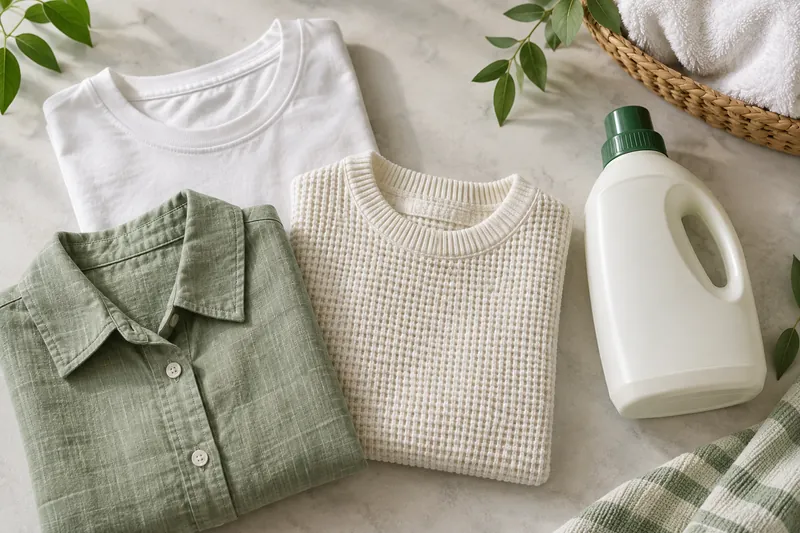
An enzyme name indicates a type of substrate the enzyme can act on; it does not describe the entire detergent. The same bottle may contain surfactants, builders and fragrance. Check both the stain-removal claim and the fabric restrictions before choosing it for a delicate item.
Look at the ingredient disclosure of a top-tier high-efficiency (HE) laundry detergent (Tide Hygienic Clean, Persil ProClean, Miele UltraPhase, 365 Unscented Powder) and compare it against a budget bargain jug. Both contain water and basic surfactants, yet the premium detergent lifts dried blood, crusty oatmeal, salad dressing, and barbecue sauce in a 30 °C (86 °F) wash without scrubbing, while the bargain detergent leaves shadowy ghosts behind. The difference is the catalytic enzyme cocktail—typically accounting for just 0.4% to 1.8% of the formula by weight, yet delivering over half of its stain-breaking power. You can see which enzyme class targets each of 28 common household stains in our Stain Chemistry × Textile Fiber Safety Lookup Matrix.
How Catalytic Hydrolases Replace High-Temperature Boiling
Before bacterial alkaline protease was introduced into European laundry powders (Bio-Tex and Ariel) in the 1960s, removing insoluble macromolecular food and body soils required boiling cotton laundry at 85–95 °C (185–203 °F) with harsh soda ash (Na₂CO₃) and mechanical washboard scrubbing.
Enzymes used in laundry are hydrolases (EC Class 3)—globular proteins engineered from Bacillus bacteria and Aspergillus / Humicola fungi that catalyze the hydrolytic cleavage of specific covalent bonds using water molecules (R-X-R' + H₂O → R-OH + H-X-R'). Because a single enzyme molecule acts as a true Michaelis-Menten catalyst, it binds a macromolecular stain polymer on the fabric surface, snips its backbone bond in milliseconds, releases the water-soluble fragments into surfactant micelles, and moves on to cleave thousands of additional bonds without being consumed:
Michaelis-Menten Surface Hydrolysis Kinetics:
  E (Enzyme) + S_insoluble (Bound Stain Polymer)  ⇌  [E·S]  ──[k_cat + H₂O]──>  E + P_soluble (Short Oligomers)
  Reaction Velocity:  v = (V_max × [S]) ÷ (K_m + [S])
  • Lowering activation energy (E_a) allows 30–40°C enzyme washes to achieve higher polymer
    cleavage rates than 65°C non-enzyme washes, saving ~60% appliance heating energy!
The Six Industrial Laundry Enzymes & Their Exact Substrates
Because an enzyme’s active site (catalytic triad) has a rigid three-dimensional geometry, enzymes obey strict lock-and-key substrate specificity. A protease cannot digest potato starch, and an amylase cannot digest bacon grease. Complete bio-detergents blend five to six complementary enzymes:
Enzyme Name & IUBMB EC Code |
Target Chemical Bond Cleaved | Target Household Stains & Soils | Optimal Temp & pH Window |
Fiber & Usage Restrictions |
|---|---|---|---|---|
| 1. Subtilisin Protease ( EC 3.4.21.62, Serine Endopeptidase) |
Internal peptide bonds (-CO-NH-) in proteins |
Blood (hemoglobin), egg, milk casein, grass proteins, sweat, meat gravy, collar keratin scales. |
25–55 °C (77–131 °F)pH 8.0–10.5 |
NEVER use on Silk, Wool, Cashmere, or Down (digests structural fibroin/keratin peptide chains!). |
| 2. Alpha-Amylase ( EC 3.2.1.1, Glycoside Hydrolase) |
Internal α(1→4) glycosidic bonds in amylose & amylopectin starch |
Pasta sauce starch, oatmeal, baby cereal, potato gravy, chocolate pudding, rice, flour paste. | 20–60 °C (68–140 °F)pH 6.5–10.0 |
Safe on all fibers (including wool and silk, as animal proteins contain zero α-1,4 starch bonds). |
| 3. Triacylglycerol Lipase ( EC 3.1.1.3, Ester Hydrolase) |
Carboxylic ester bonds at sn-1 and sn-3 of triglycerides |
Human sebum collar rings, butter, olive/cooking oils, mayonnaise, lipstick, bacon drippings. | 25–45 °C (77–113 °F)pH 7.5–10.5 |
Works primarily during the drying phase between wash cycles as residual enzyme hydrolyzes trapped fats. |
| 4. Beta-Mannanase ( EC 3.2.1.78, Endo-β-1,4-Mannanase) |
β(1→4) mannosidic bonds in galactomannan gums |
Guar gum & locust bean gum thickeners in ice cream, BBQ sauce, ranch dressing, toothpaste, cosmetics. | 20–55 °C (68–131 °F)pH 7.0–10.0 |
Essential for modern processed foods: un-cleaved guar gum forms an invisible sticky glue that traps dirt from the wash water! |
| 5. Pectate Lyase ( EC 4.2.2.2 / Pectinase) |
α(1→4) galacturonan backbone of plant pectins |
Jam, jelly, mashed berries, tomato paste, baby fruit purées, grass cell-wall pectins. | 20–50 °C (68–122 °F)pH 7.5–9.5 |
Prevents gelatinous fruit pectin films from binding particulate clay and soot to cotton shirts. |
| 6. Endoglucanase Cellulase ( EC 3.2.1.4, β-1,4-Glucanase) |
Amorphous β(1→4) cellulose surface microfibrils (not food stains!) |
Fabric care & anti-pilling: snips fuzzy broken cotton microfibrils that scatter light and trap body oil. | 30–50 °C (86–122 °F)pH 6.5–9.5 |
Restores black/color vibrancy on cotton knits (Cellulase Antipilling Guide); avoid excessive soaking on fragile antique linen. |
Why “Mannanase” and “Lipase” Are the Secret Dividers in Detergent Quality
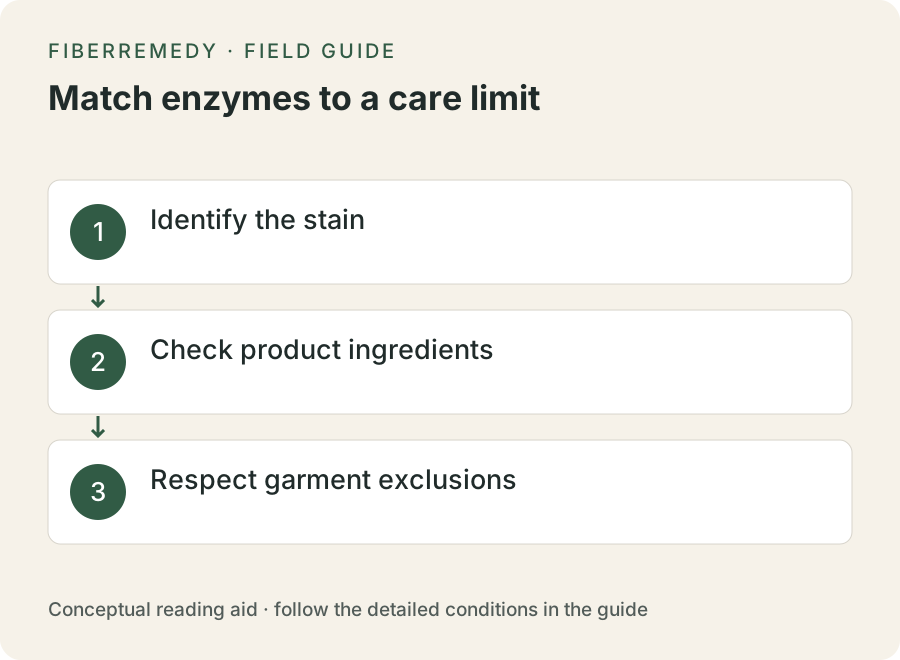
Many mid-tier liquid detergents advertise “Contains Stain-Fighting Enzymes” on the front label while including only inexpensive protease and amylase. Why do those detergents fail on modern food spills and collar grime?
- The Hidden Galactomannan Gum Trap (
Why Mannanase Matters): Almost every commercial salad dressing, barbecue sauce, ketchup, ice cream, yogurt, and body lotion uses guar gum or locust bean gum (β-1,4-D-mannopyranosebackbone withα-1,6-galactoseside branches) as a rheology modifier. Neither protease nor amylase can touchβ-1,4mannan bonds. Without β-mannanase (EC 3.2.1.78), an invisible, colorless patch of guar gum remains adsorbed to the cotton fibers after washing—and the next time you wear or wash that shirt, the sticky mannan patch captures fugitive dyes and soot like flypaper, creating a mysterious gray spot days later! - Interfacial Activation of Lipase (
EC 3.1.1.3): Lipase possesses an amphiphilic helical “lid” covering its catalytic triad (Ser-His-Asp) that opens only when the enzyme adsorbs at an oil-water interface. Because lipase acts most rapidly when water activity drops during spinning and drying, fabrics washed with a lipase-containing detergent release remaining triglyceride fragments cleanly on the subsequent wash cycle.
Thermal Denaturation (> 60 °C) and Bleach Inactivation Rules
Because laundry enzymes are themselves folded globular proteins stabilized by calcium ions (Ca²⁺ binding loops), three wash-room mistakes destroy their catalytic activity before they can clean your clothes:
- Boiling Water Denaturation (
> 60–65 °C / 140–149 °F): Detergent enzymes reach peak catalytic turnover (k_cat) between30 °C and 50 °C (86 °F and 122 °F). Above60 °C, thermal agitation unfolds the enzyme’s tertiary structure (denaturation). If washing white cotton sheets on a60 °Cor75 °Csanitize cycle, choose a machine program that starts with a warm35–40 °Cenzymatic pre-wash step (15–20 minutes) before the internal heater ramps to60 °C+. - Chlorine Bleach (
NaOCl) Destroys Enzymes Instantly: Sodium hypochlorite (OCl⁻) is a non-selective strong oxidizer. Adding liquid chlorine bleach to the main wash oxidizes the methionine (Met-222in subtilisin) residue right next to the catalytic serine into methionine sulfoxide within seconds, dropping enzyme activity by> 90%. By contrast, modern bleach-stable engineered enzymes (Duramyl,Savinase/Everlase) tolerate sodium percarbonate (OxiClean,H₂O₂ / HOO⁻) throughout a 60-minute soak (Sodium Percarbonate vs. Sodium Hypochlorite Guide). - Why Liquid Detergents Need Borate (
H₃BO₃ / Na₂B₄O₇) Stabilizers: In a bottle of liquid detergent (70–85% water), active subtilisin protease will slowly cannibalize (auto-digest) itself and the amylase/lipase molecules in the bottle! Formulators prevent this by adding1–3%boric acid / sodium tetraborate (borax) or 4-formylphenylboronic acid (4-FPBA), which forms a reversible tetrahedral complex with the protease’s catalytic serine inside the bottle, then dissociates immediately upon200×dilution in the washing machine drum!
To avoid ruining delicate protein yarns while using enzyme detergents, cross-check your garment’s care label in our ISO 3758 & ASTM D5489 Care Symbol Decoder and review Wool and Cashmere Felting Mechanics.
Practical check: what to observe
Compare complete products under their label directions rather than adding isolated enzyme powders. Record stain, fiber, temperature and contact time. A stain that remains may need a different compatible approach, but longer soaking is not automatically safer or more effective.
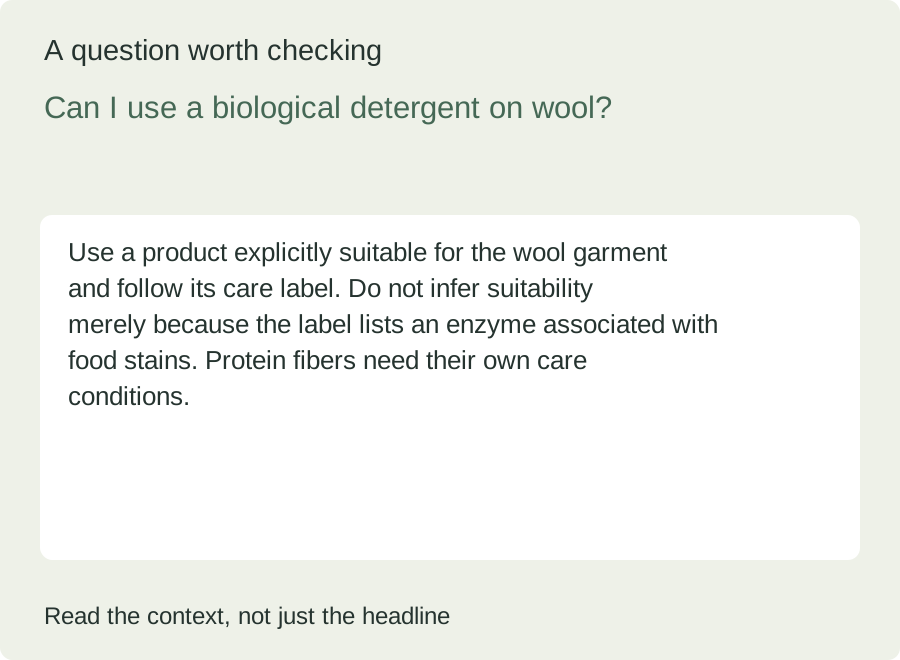
- Identify the stain
- Check product ingredients
- Respect garment exclusions
Can I use a biological detergent on wool?
Use a product explicitly suitable for the wool garment and follow its care label. Do not infer suitability merely because the label lists an enzyme associated with food stains. Protein fibers need their own care conditions.
For more context, see the topic FAQ and glossary. A reference value or example should be read with its units, assumptions and product-specific conditions.
Sources and scope
The references below were supplied with the original manuscript. A reference is not evidence that every numerical claim has been independently checked. See the source library and our verification status.
- IUBMB Enzyme Nomenclature Database – Hydrolases (EC 3.1, EC 3.2, and EC 3.4 Classifications)
- Journal of Biological Chemistry – Catalytic Triad and Oxidative Stability of Subtilisin Serine Proteases
- Applied Microbiology and Biotechnology – Industrial Detergent Enzymes: Engineering for Cold-Water and Alkaline Detergency
Put the explanation to work
Continue reading
Spot a questionable claim or a calculation issue? Read our correction process and contact information. Examples and illustrations are educational; they do not establish product suitability or a laboratory result.