 FiberRemedy
Natural Fiber Mechanics & Dye Fastness
Wool and cashmere: washing without felting
Two wool sweaters can have different care labels because their construction and finishing differ.
Before you start
Two wool sweaters can have different care labels because their construction and finishing differ. Machine-washable wool is not a blanket permission to use any cycle. Check temperature, mechanical action and drying together; changing just the detergent cannot compensate for an unsuitable wash program.
Every winter, an expensive merino wool or Scottish cashmere sweater is accidentally tossed into a standard 40 °C cotton wash cycle with heavy-duty laundry detergent and tumbled dry—emerging forty-five minutes later shrunk to the size of a toddler’s garment and stiff as a wool felt Fedora hat. Unlike a cotton T-shirt that shrinks by 3–5% due to weave tension relaxation and stretches back out when worn, wool felting shrinkage (20% to 50% area loss) is a one-way mechanical and chemical ratchet that can be irreversible. Understanding the cuticular scale anatomy, Directional Frictional Effect (DFE), and keratin disulfide/salt-bridge pH chemistry of animal hair fibers helps explain why the garment label and appropriate handling matter for fine wool, cashmere, mohair, and alpaca. Decode the two-bar wool wash tub ([Tub ==]) and flat-dry square ([□ —]) symbols in our ISO 3758 & ASTM D5489 Garment Care Symbol Decoder.
Cuticular Scale Anatomy & The Directional Frictional Effect (DFE)
Plant cellulose fibers (cotton, linen) and synthetic filaments (polyester, nylon) have relatively smooth longitudinal surfaces: sliding two cotton fibers against each other produces the same coefficient of friction in either direction (µ_1 = µ_2).
Animal hair fibers (Merino wool d ≈ 16–22 µm, Cashmere d ≈ 14–16 µm, Alpaca) have a complex hierarchical protein architecture:
- Inner Paracortex & Orthocortex (
90%of fiber mass): Spindle-shaped cortical cells packed with alpha-helical keratin intermediate filaments cross-linked by high concentrations (~10–12%of amino acid residues) of cystine disulfide bridges (-CH₂-S-S-CH₂-), ionic salt bridges (-NH₃⁺ ··· ⁻OOC-), and hydrogen bonds. - Outer Cuticle Scale Sheath (
10%of mass): Overlapping roof-tile-like cuticular scales (~0.5–0.8 µmthick,10–20 µmexposed length) whose free, jagged edges always point toward the tip of the hair shaft (away from the follicle root). In dry air, this scale surface is coated in a covalently bound monolayer of 18-methyleicosanoic acid (18-MEA), making virgin wool naturally water-repellent on the outside while its core can absorb30%of its weight in water vapor!
Because the overlapping scale edges point toward the fiber tip like microscopic barbed fishhooks or a pine cone, sliding a wet wool fiber root-first (with the scales, µ_with) encounters low friction, whereas sliding it tip-first (against the scale barbs, µ_against) catches the opposing scales and encounters high friction:
Directional Frictional Effect (DFE) Ratchet Equation (Speakman / Martin Model):
  DFE = (µ_against - µ_with) ÷ (µ_against + µ_with)
  • Dry Merino Wool in Air:              µ_against ≈ 0.28,  µ_with ≈ 0.17  (DFE ≈ 0.24)
  • Wet Wool in Neutral Water (pH 6.5):  µ_against ≈ 0.48,  µ_with ≈ 0.22  (DFE ≈ 0.37)
  • Wet Wool in Alkaline Soap (pH 10.2): µ_against ≈ 0.65,  µ_with ≈ 0.21  (DFE ≈ 0.51 — Maximum Felting!)
When a wet sweater is tumbled and flexed in a washing machine drum, compressive and shear forces push individual wool fibers slightly. Because µ_against >> µ_with, every fiber can only travel in one direction—root-end first—and can never slide backward! With each drum rotation, fibers worm deeper into neighboring yarns, coiling and locking tightly until the loosely knitted sweater compacts into dense, un-unravelable felt.
Why Alkaline pH (> 8.5), Heat, and Protease Destroy Keratin
Why does washing wool in an alkaline detergent (pH 9.5–10.5) or sodium percarbonate (OxiClean, pH 10.5) double the felting speed and leave the yarn rough, yellowed, and brittle? Look at the three stabilizing bonds inside α-keratin:
Keratin Bond Stability vs. Wash Liquor pH and Temperature:
  1. Isoelectric Point (pI ≈ 4.5 – 5.0):
     Between pH 4.5 and 7.0, protonated lysine/arginine (-NH₃⁺) and deprotonated glutamate/aspartate (-COO⁻)
     form maximum ionic SALT BRIDGES, keeping the keratin cortex compact and scale edges flat.

  2. Alkaline Swelling & Disulfide Cleavage (pH > 8.5):
     • Above pH 8.5, -NH₃⁺ groups deprotonate into neutral -NH₂, breaking ionic salt bridges and causing
       the fiber diameter to swell by +18–25%, lifting the outer cuticular scale barbs wide open!
     • Above pH 9.5 (especially > 40°C), hydroxide ions (OH⁻) attack cystine disulfide bridges (-S-S-)
       via β-elimination, forming dehydroalanine and cross-linked LANTHIONINE (-CH₂-S-CH₂-, yellowing!).

  3. Protease Enzyme Hydrolysis (Subtilisin EC 3.4.21.62):
     • Protease enzymes in standard bio-detergents cannot distinguish a bloodstain from a cashmere sweater;
they cleave peptide bonds along the scale junctions, causing fiber fibrillization and holes.| Wash Condition / Parameter | Safe Merino & Cashmere Conservation Limit | What Happens If Limit Is Violated |
|---|---|---|
Wash Liquor pH |
pH 5.0 – 7.5 (Neutral or slightly acidic syndet) |
pH > 8.5 breaks salt bridges, swells scales open, and cleaves -S-S- bonds. |
| Water Temperature | 20–30 °C (68–86 °F) — keep wash & rinse identical! |
> 35–40 °C plasticizes wet α-keratin H-bonds; hot-to-cold shock triggers scale locking. |
| Mechanical Agitation | Gentle hand press or ISO [Tub ==] Wool Cradle Cycle |
Normal drum tumbling drives root-first DFE ratchet migration (irreversible felt). |
| Enzyme / Bleach Chemistry | Zero Protease · Zero Percarbonate · Zero NaOCl |
Protease digests peptide backbone; NaOCl dissolves wool completely into yellow slime. |
| Drying Geometry | Press in towel + Dry Flat (ISO [□ —]) in shade |
Hanging a wet wool sweater stretches wet plasticized α-helices into β-sheets (+6 inches!). |
(How “Superwash” Machine-Washable Wool Works: Under the commercial Chlorine-Hercosett process, raw wool top is lightly chlorinated to etch away the jagged scale tips and coated with a ~1% polyamide-epichlorohydrin resin layer that masks the DFE ratchet (µ_against ≈ µ_with). Even on Superwash wool, avoid protease detergents and high heat to preserve the resin shell.)
Step-by-Step Hand-Wash & De-Scenting Protocol for Cashmere and Merino
Because dry wool’s outer 18-MEA lipid layer repels liquid spills while its inner cortex absorbs and releases odor vapors during airing, air your wool sweaters on a flat surface or padded hanger for 24 hours between wears—they typically require wet washing only after 5 to 8 wears (or before summer moth-proof storage):
- Prepare a
28 °C (82 °F)Neutral Syndet Bath: Fill a clean basin with lukewarm-cool water (25–30 °C, feels neither hot nor icy to your wrist) and dissolve1 teaspoonof a protease-free, pH-neutral (pH 6.0–7.2) nonionic/amphoteric wool wash (Eucalan,Soak,Woolite Delicates, or pure baby shampoo). For targeted stain removal before soaking, check the Wool/Silk column of our Stain Chemistry × Fiber Safety Matrix. - Submerge & Soak Without Rubbing (
15–20 Minutes): Turn the sweater inside-out, gently press it underwater so trapped air escapes, and let Sinner’s Time factor replace Mechanical Action for15 to 20 minutes. Never scrub two wet wool surfaces together. - Same-Temperature Rinse + Optional
pH 5.0Acid Scale-Closing Rinse: Drain the basin while supporting the wet sweater (never lift a heavy soaking-wet sweater by its shoulders!). Refill with clean water at the exact same28 °Ctemperature plus1 tablespoonof distilled white vinegar (5%acetic acid). The mildly acidicpH ~5.0rinse restores keratin’s isoelectric salt bridges and flattens the cuticular scales, leaving the yarn noticeably softer. - Towel Roll & Flat Blocking (
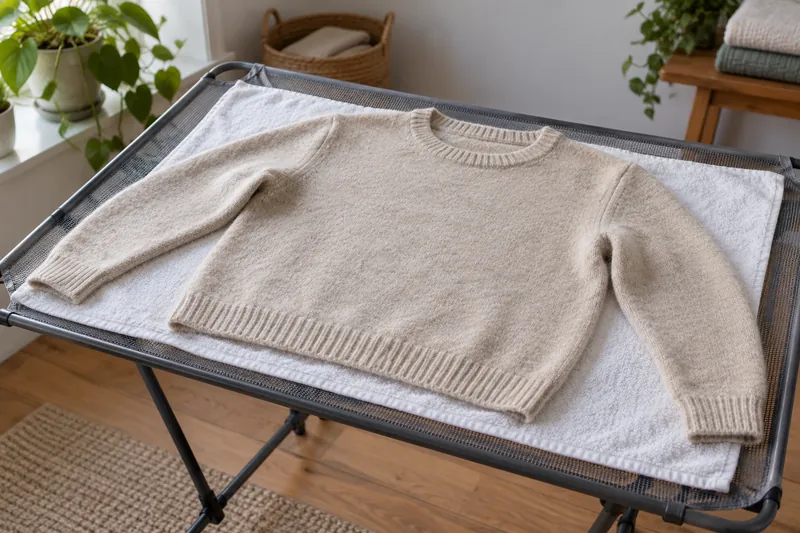
ISO [□ —]): Lay the wet sweater flat on a clean white cotton bath towel, roll the towel up like a jelly roll, and press down gently with your palms to wick out70%of the water (never twist or wring!). Unroll, reshape the cuffs, hem, and collar to their original measurements on a dry mesh rack or second dry towel away from direct radiators or sunlight.
Practical check: what to observe
Measure the dry garment before washing if fit is important. Support its weight when wet and follow the stated drying method. For structured, embellished or valuable knitwear, ask a qualified cleaner before trying to stretch or chemically treat it.
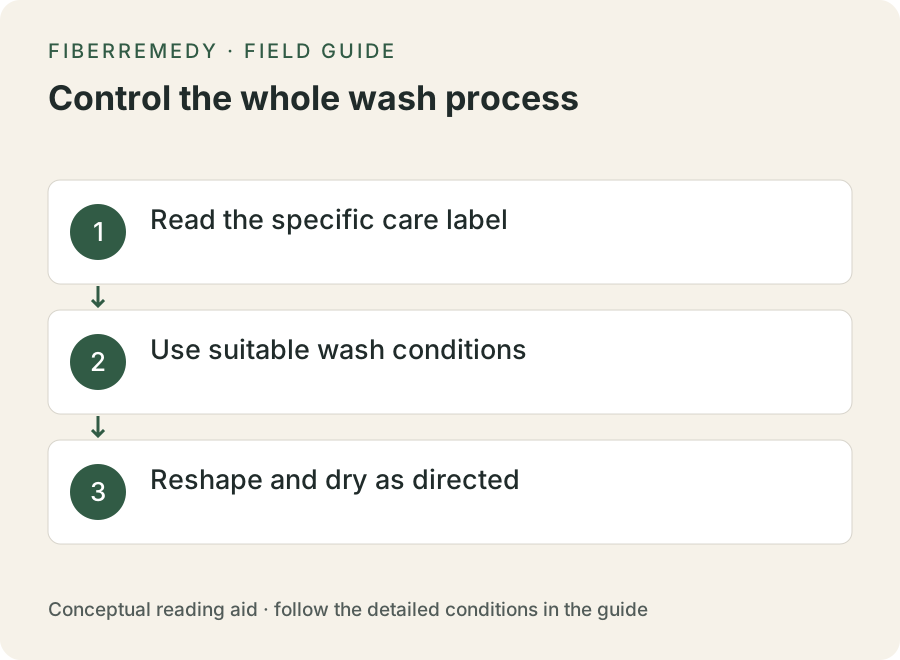
- Read the specific care label
- Use suitable wash conditions
- Reshape and dry as directed
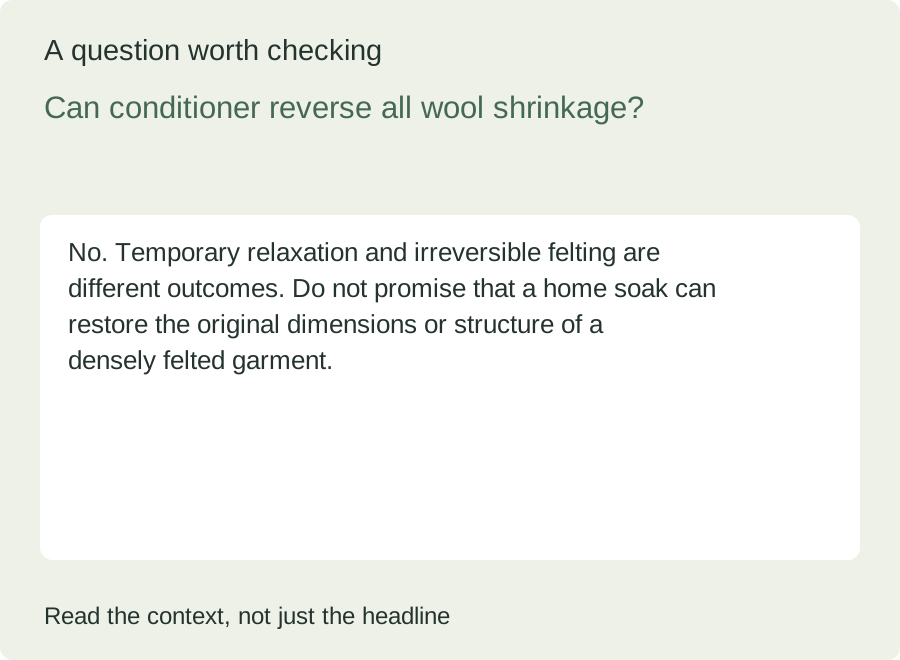
Can conditioner reverse all wool shrinkage?
No. Temporary relaxation and irreversible felting are different outcomes. Do not promise that a home soak can restore the original dimensions or structure of a densely felted garment.
For more context, see the topic FAQ and glossary. A reference value or example should be read with its units, assumptions and product-specific conditions.
Sources and scope
The references below were supplied with the original manuscript. A reference is not evidence that every numerical claim has been independently checked. See the source library and our verification status.
- Wool Science: The Chemical Reactivity of the Wool Fibre (John A. Maclaren & Brian Milligan, CSIRO)
- Textile Research Journal – The Directional Frictional Effect (DFE) and Mechanics of Wool Felting Shrinkage
- The Woolmark Company Technical Specification – Machine-Washable (Superwash) vs. Hand-Wash Merino Care
Put the explanation to work
Continue reading
Spot a questionable claim or a calculation issue? Read our correction process and contact information. Examples and illustrations are educational; they do not establish product suitability or a laboratory result.