 FiberRemedy
Enzymes, Surfactants & Water Chemistry
Yellow underarm stains and deodorant buildup
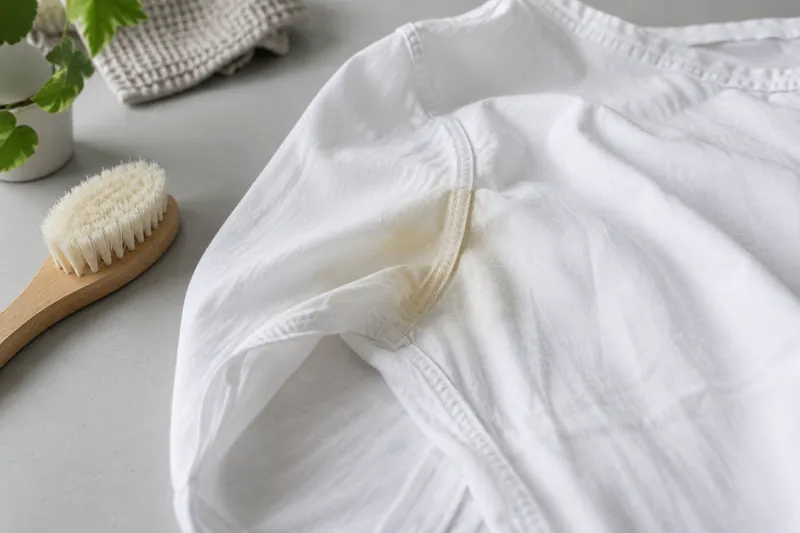
An underarm mark can include body oil, product residue and a change in fabric color.
Before you start
An underarm mark can include body oil, product residue and a change in fabric color. A stiff patch and a weakened seam require different decisions. Check the garment when dry and compare with an unaffected area before applying stronger treatment.
Every wardrobe suffers from the same slow-motion casualty: white cotton T-shirts and dress shirts develop stiff, yellow-brown underarm halos, while dark polo shirts and athletic jerseys develop chalky white or gray “cardboard” crusts in the armpit seams that refuse to wash out in a normal laundry cycle. Worse, soaking those yellow armpits in household chlorine bleach (NaOCl) turns the yellow patches an even darker, permanent amber-brown. Understanding the inorganic coordination chemistry of aluminum-zirconium antiperspirant salts and how they co-precipitate with apocrine sweat proteins and sebum lipids reveals why ordinary alkaline detergent (pH 9–10) fails—and how a two-stage acidic chelation + enzymatic lipid strip dissolves decades-old crust completely. You can compare underarm antiperspirant buildup against pure sweat and sebum stains in our Stain Chemistry × Textile Fiber Safety Lookup Matrix.
The Chemistry of Antiperspirants: Why Aluminum Salts Gel at Neutral pH
First, distinguish a deodorant (which contains antimicrobial alcohols, parfum, or baking soda to mask odor) from an antiperspirant (regulated by the FDA as an over-the-counter drug that physically plugs eccrine sweat ducts). Almost every stick, roll-on, and clinical antiperspirant relies on water-soluble acidic polymeric metal salts:
- Aluminum Chlorohydrate (
ACH,[Al₂(OH)₅Cl] · 2H₂O): AqueouspH ≈ 4.0–4.4. - Aluminum Zirconium Tetrachlorohydrex Gly (
AZG): Complexes ofAl³⁺andZr⁴⁺buffered with the amino acid glycine atpH ≈ 3.4–4.2.
How do these salts stop sweat on skin—and why do they turn shirt armpits into stiff cardboard? At the low pH (3.5–4.4) inside the antiperspirant stick, aluminum and zirconium exist as soluble cationic polyhydroxy complexes ([Al₁₃O₄(OH)₂₄(H₂O)₁₂]⁷⁺). The moment they mix with neutral-to-slightly-acidic human sweat (pH 5.5–6.8)—or hit an alkaline laundry wash bath (pH 9.0–10.5)—the rise in pH triggers olatio/oxolation hydrolysis, precipitating an insoluble, cross-linked amorphous aluminum/zirconium hydroxide gel (Al(OH)₃(s) / Zr(OH)₄(s)):
1. pH-Triggered Gelation of Antiperspirant Salts Inside Cotton Yarn Lumens:
   [Al₂(OH)₅Cl](aq) (Soluble at pH < 4.3) + OH⁻ (Sweat / Alkaline Wash Water pH 7–10)
     ──>  2 Al(OH)₃(s)↓ (Insoluble Amorphous Hydroxide Gel Plug) + Cl⁻(aq)

2. Co-Precipitation (Mordanting) of Sebum Squalene, Wax Esters & Sweat Proteins:
   • Positively charged Al³⁺ / Zr⁴⁺ hydroxide surfaces act as a classic textile MORDANT
     (identical to how historical dyers used alum to fix dyes permanently to cotton!).
   • They electrostatically bind negatively charged carboxylate groups (-COO⁻) of sweat proteins,
     free fatty acids, and anionic laundry surfactants (LAS), encapsulating hydrophobic
     sebum squalene and cholesterol inside an inorganic-organic mineral crust!
Once trapped inside that Al(OH)₃ mineral cage, unsaturated squalene (C30H50, 6 double bonds) and cholesterol from human sebaceous glands undergo slow air autoxidation into conjugated yellow-brown hydroperoxides and carbonyl chromophores—creating the classic yellow underarm halo.
Why Alkaline Laundry Detergent and Chlorine Bleach Fail (or Worsen the Stain)
Look at the amphoteric solubility curve of Aluminum Hydroxide (Al(OH)₃) across the pH scale:
- Acidic Dissolution Zone (
pH < 4.0):Al(OH)₃protonates and dissolves completely into soluble hexaaquaaluminum(III) cations (Al(OH)₃ + 3H⁺ → Al³⁺(aq) + 3H₂O), especially when assisted by a chelating organic acid like citrate (Cit³⁻) or oxalate (C₂O₄²⁻). - Insoluble Precipitation Zone (
pH 4.5 to 9.5):Al(OH)₃is virtually 100% insoluble in water (K_sp ≈ 1.3 × 10⁻³³)! Because standard liquid high-efficiency (HE) laundry detergents operate atpH 7.8 to 9.2, a normal wash cycle cannot dissolve the aluminum hydroxide matrix. Even worse, anionic surfactants (LAS) in the detergent react withAl³⁺to precipitate sticky aluminum sulfonate soap curds on top of the crust! - Why Chlorine Bleach (
NaOCl) Is Forbidden: Applying sodium hypochlorite to an underarm stain oxidizes the trapped sweat urea and keratin/albumin proteins into bright yellow-brown N-chloramines and cross-links the protein-metal complex permanently.
| Underarm Deposit Layer | Chemical Identity | Soluble in Standard pH 8.5 Wash? |
Specific Chemical Reagent Required |
|---|---|---|---|
| 1. Mineral Mortar Matrix | Polymeric Al(OH)₃ & Zr(OH)₄ hydrogel |
NO (K_sp = 10⁻³³ at pH 5–9) |
Acidic Chelation (pH 2.2–3.5): Citric acid, white vinegar (5–10%), or dilute oxalic acid. |
| 2. Waxy Lipid Binder | Human sebum (squalene, wax esters, C16/C18 triglycerides) + deodorant stearyl alcohol / silicones |
No in cold water (melting point 38–55 °C) |
Neat Nonionic Surfactant + Lipase (EC 3.1.1.3) at 45–50 °C (113–122 °F). |
| 3. Denatured Protein Mesh | Apocrine sweat proteins, mucins, & shed stratum corneum keratin | Poorly soluble once mordanted to Al³⁺ |
Subtilisin Protease (EC 3.4.21.62) after the Al³⁺ mineral cage is acid-stripped. |
| 4. Yellow Chromophores | Oxidized squalene peroxides, lipofuscin, & bacterial corynebacteria porphyrins | No (covalently/hydrophobically bound) | Sodium Percarbonate (OxiClean, HOO⁻) warm oxygen-bleach soak (Stage 2). |
The Two-Stage Reversal Protocol: Acidic Chelation First, Alkaline Enzyme + Oxygen Second
Because acids (pH 2.8) dissolve the inorganic aluminum plug while alkaline enzymes + sodium percarbonate (pH 10.5) dissolve the unlocked sebum, protein, and yellow chromophores, you must apply them in two separate stages with a water rinse in between (mixing vinegar and OxiClean/baking soda together in one bowl simply neutralizes both into useless salt water!).
Stage 1 — Acidic Aluminum-Zirconium De-Mordanting (pH 2.5–3.2, 45–60 min):
  Al(OH)₃(s) (Insoluble Crust) + H₃Citrate(aq) (Citric Acid)
    ──>  [Al(Citrate)]⁰(aq) (Water-Soluble Aluminum Citrate Chelate, log K ≈ 8.0) + 3 H₂O

  ──[Rinse Thoroughly in Warm Water to Flush Dissolved Al³⁺ / Zr⁴⁺ Down the Drain!]──>

Stage 2 — Alkaline Enzymatic & Perhydroxyl Chromophore Strip (pH 10.2, 45–50°C, 2–4 hr):
  Unlocked Sebum + Sweat Proteins + Yellow Squalene Chromophores
    ──[Nonionic Surfactant + Lipase + Protease + Sodium Percarbonate (HOO⁻)]──>  Soluble Micelles & Colorless Salts
Step-by-Step Workshop Instructions (For Cotton & Synthetic Shirts)
- Stage 1 (Acidic Aluminum Chelation Bath —
60 Minutes):- Dissolve
2 tablespoons (30 g)of food-grade citric acid powder (or pour2 cupsof5%distilled white vinegar) into2 quarts (2 L)of warm water (40 °C / 104 °F), plus1 teaspoonof liquid dish soap (Dawn, whose nonionic/anionic surfactants wet the waxy crust even at lowpH). - Submerge the shirt underarms, scrub the stiff crust gently with a soft nylon toothbrush to help acid penetrate the yarn bundle, and soak for 60 minutes. (For extreme, years-old yellowed white cotton dress shirts, a 10-minute spot treatment with
2%oxalic acid / Bar Keepers Friend paste chelates bothAl³⁺and traceFe³⁺iron instantly.) - Crucial Intermediate Rinse: Rinse the underarms thoroughly under warm running tap water to flush the dissolved aluminum-citrate ions out of the fabric before moving to Stage 2.
- Dissolve
- Stage 2 (Enzymatic + Oxygen Bleach Strip —
2 to 4 Hours):- Massage
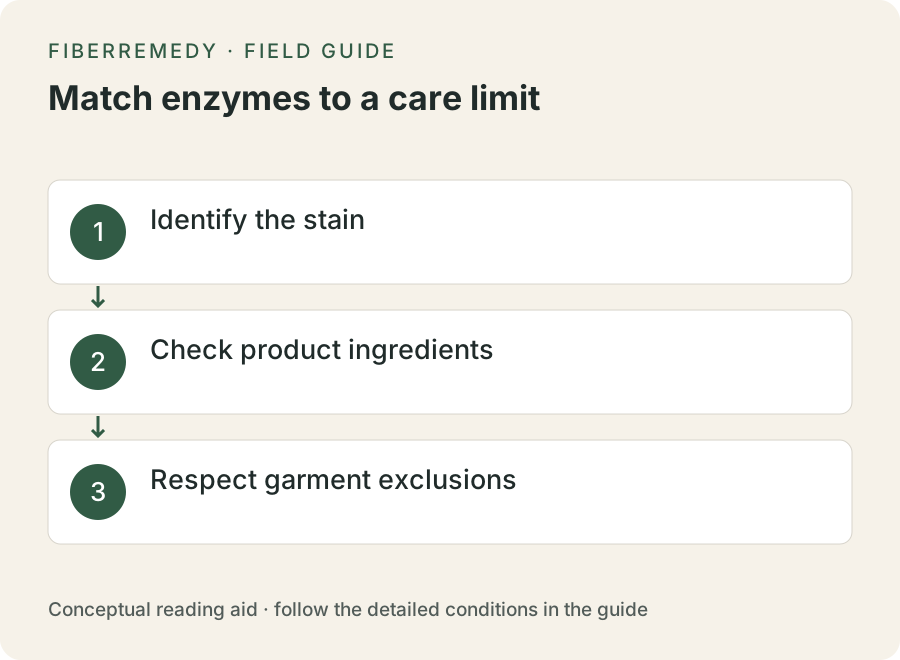
1 teaspoonof heavy-duty enzyme liquid detergent (protease + lipase; see Laundry Enzymes Explained) directly into each wet armpit. - Dissolve
2 tablespoonsof sodium percarbonate (OxiClean) (Sodium Percarbonate vs. Hypochlorite Guide) in1 gallonof50 °C (122 °F)water, soak the shirt for 2 to 4 hours, and launder on a warm cycle.
- Massage
(Note for Merino Wool or Silk Sweaters: Perform Stage 1 only using 1 part white vinegar : 3 parts cool 28 °C water + neutral wool wash for 30 minutes, then wash gently in cool water. Never use Stage 2 protease or sodium percarbonate on wool or silk!)
Practical check: what to observe
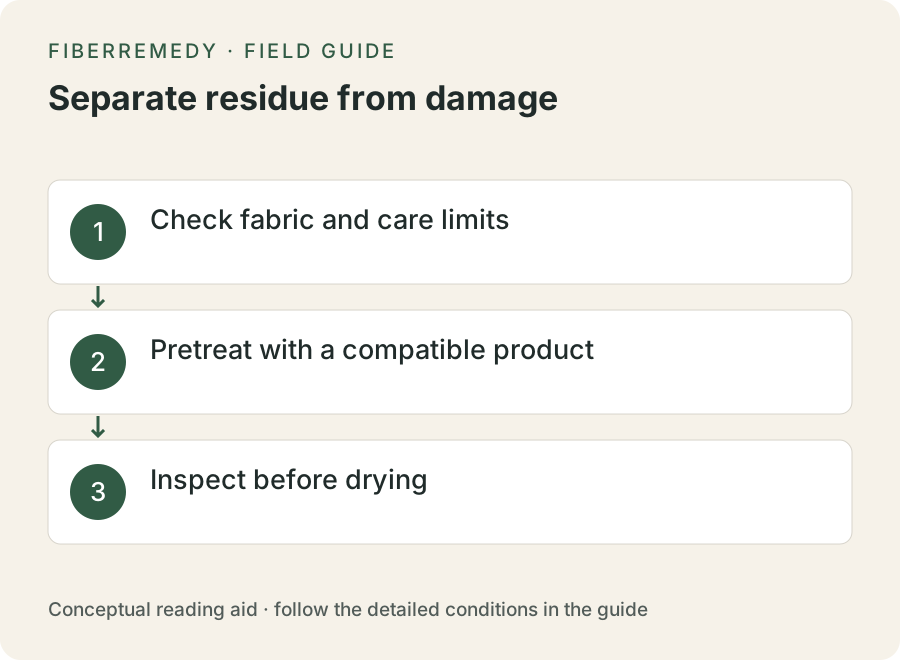
Use the labeled contact time and rinse as directed. Do not add chlorine bleach to an acidic treatment or other cleaner. If a patch is thin, brittle or losing color, stop repeated treatment; removal of residue cannot rebuild damaged fibers.
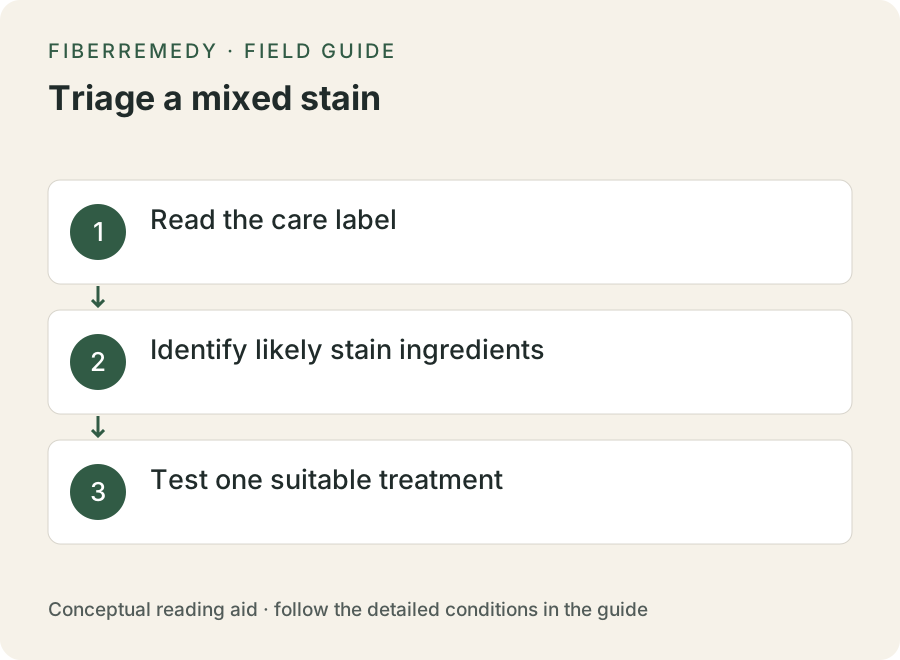
- Check fabric and care limits
- Pretreat with a compatible product
- Inspect before drying
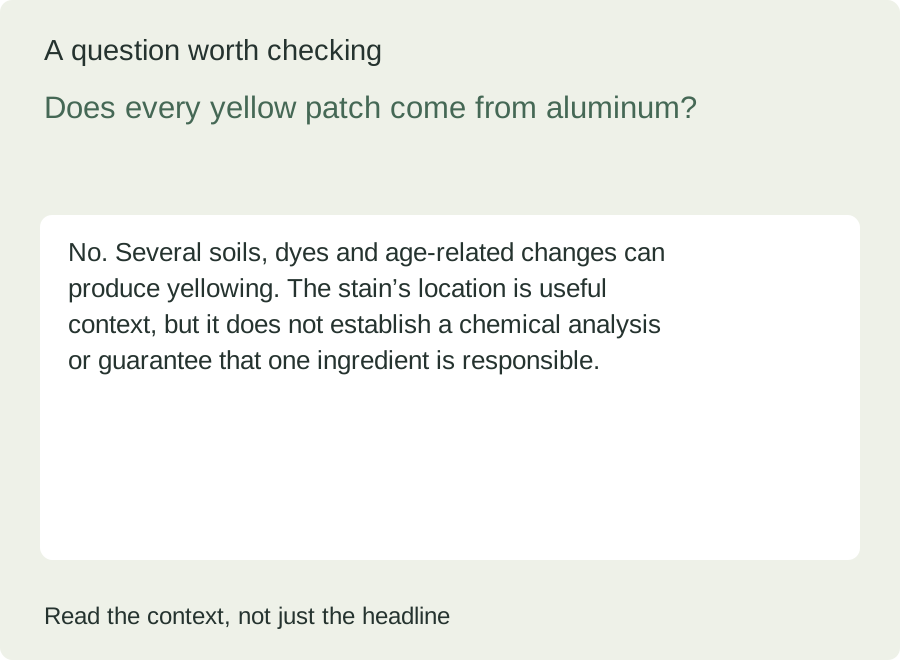
Does every yellow patch come from aluminum?
No. Several soils, dyes and age-related changes can produce yellowing. The stain’s location is useful context, but it does not establish a chemical analysis or guarantee that one ingredient is responsible.
For more context, see the topic FAQ and glossary. A reference value or example should be read with its units, assumptions and product-specific conditions.
Sources and scope
The references below were supplied with the original manuscript. A reference is not evidence that every numerical claim has been independently checked. See the source library and our verification status.
- Journal of Cosmetic Science – Hydrolysis and Gelation Chemistry of Aluminum Chlorohydrate and Aluminum-Zirconium Antiperspirant Actives
- Textile Research Journal – Mechanism of Underarm Yellowing: Interaction of Antiperspirant Metal Salts, Sebum Squalene, and Apocrine Sweat on Cotton
- AATCC Review – Chelation and Surfactant Strategies for Removing Mixed Inorganic-Organic Antiperspirant Soils
Put the explanation to work
Continue reading
Spot a questionable claim or a calculation issue? Read our correction process and contact information. Examples and illustrations are educational; they do not establish product suitability or a laboratory result.