 FiberRemedy
Explainers
Pack clothes you can care for: a travel wardrobe washing plan
Match your travel wardrobe to the washing and drying facilities you will actually have, using care labels as the starting point.

Before you start
Before packing, match each garment’s permitted care to the facilities at your destination. A piece that is easy to wear can still be awkward to clean or dry during a short stay. Plan the complete cycle, not just access to a washing machine.
Think in complete care cycles
A travel wardrobe must fit both the trip and the available care routine. A machine nearby does not solve a garment that needs a drying surface you do not have. Conversely, an item that requires no cleaning during a short visit may be simpler than planning an unfamiliar process away from home.
This article offers a planning template. It does not predict exact drying times, which depend on the garment and environment.
Read the labels before the suitcase is full
GINETEX explains that care information describes permitted treatment of the whole textile article. That makes the actual label a better planning source than a broad assumption about a fiber.
Lay out the clothes and group them by compatible care route. Keep items needing special handling visible. If a label is missing or unclear, resolve the question before the trip rather than in a shared laundry room late at night.
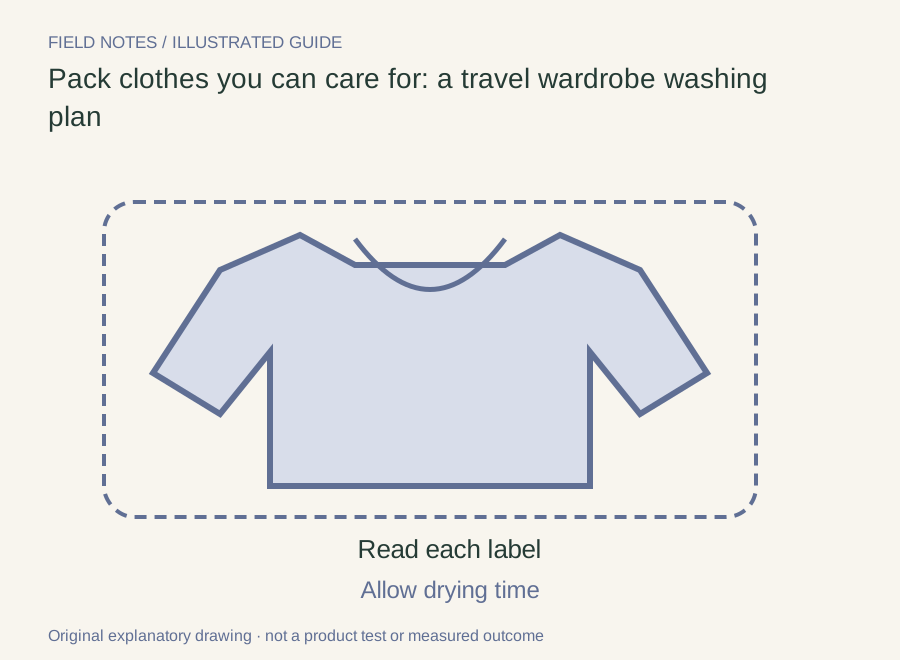
Build a realistic packing table
| Item | Care route to confirm | Drying arrangement | Backup |
|---|---|---|---|
| Everyday shirt | Its permitted machine cycle | Its permitted rack or dryer method | Another clean shirt |
| Wool layer | Label-specific washing route | Space and support required by the label | Airing or postponing washing when appropriate |
| Structured jacket | Professional or other specified care | Suitable service and turnaround | Avoid scheduling an untested wash |
These are planning prompts, not instructions for all shirts, wool garments or jackets. Fill in the table from the items you own.
Check facilities with useful questions
Ask whether the accommodation has a machine you can operate, which drying options are available and whether there is a suitable place for a garment that must dry flat. If you need a professional service, check what it accepts and when it returns items.
Avoid assuming that the word “delicate” on an unfamiliar machine matches your garment’s care requirements. Read the machine instructions and keep incompatible items separate.
Pack instructions as well as products
Keep a private photograph of essential care labels on your phone. If taking a product, preserve enough of its identity and directions to use it correctly and comply with the transport rules that apply to your trip. An unmarked bottle creates a new problem if you forget its concentration.
Cheryl Mendelson’s Laundry provides a broader reference for textile care. Woolmark’s sweater guide is a more focused starting point for an appropriate wool item.
Plan a fallback that does not require a risky wash
An extra compatible layer, a revised outfit or a suitable cleaning service can be a better fallback than improvising on a valuable garment. The aim is enough clean, wearable clothing for the trip, not proving that every item can be washed anywhere.
Before leaving, run through the table once: what can be washed together, what must be kept separate, where each item can dry and what happens if it is not ready. Our drying-first laundry plan applies the same sequence at home.

Practical check: what to observe
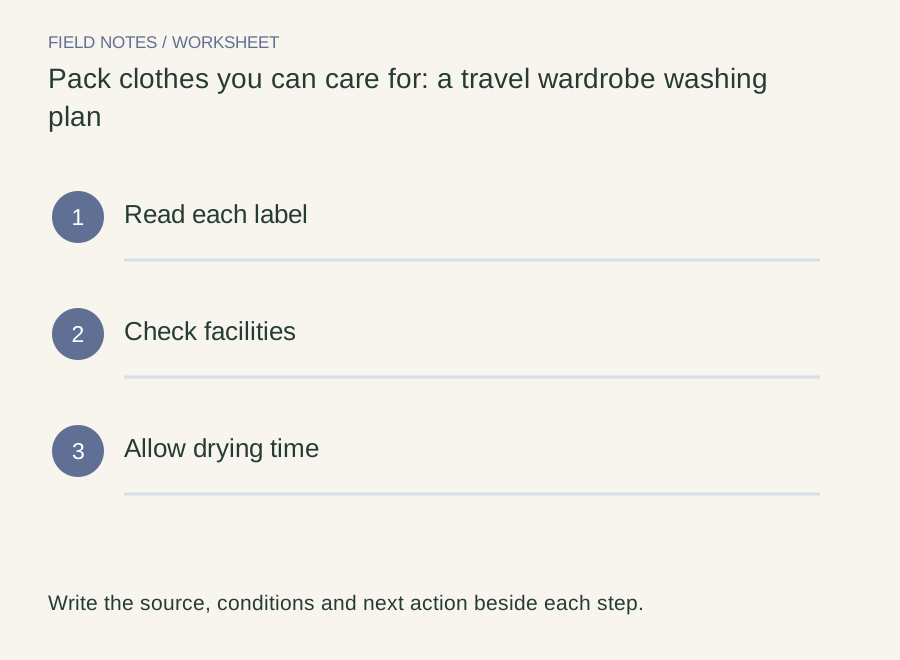
Create a small packing table with permitted washing method, drying method and an alternative if the item is not ready in time. Confirm the facilities with the accommodation instead of assuming every laundry room offers the same settings.
- Read each label
- Check facilities
- Allow drying time
Can I assume a hotel sink is suitable for every delicate item?
No. Hand washing is a care method, not a universal fallback. The garment label, available product, workspace and drying arrangement still need to be compatible.
For more context, see the topic FAQ and glossary. A reference value or example should be read with its units, assumptions and product-specific conditions.
Sources and scope
The reading below provides context for the relevant care or brewing principles. The article’s scenarios and decision questions are original editorial explanations, not independent product tests. Read the editorial policy for sourcing, AI assistance and corrections.
- GINETEX — Care Labelling
Explains the scope of care instructions. Official symbol artwork is not reproduced here.
- Cheryl Mendelson — Laundry: The Home Comforts Book of Caring for Clothes and Linens
Publisher description used for reading selection, not endorsement of every treatment in the book.
- Woolmark — How to Wash a Wool Sweater
Choose the method permitted by the actual garment care label.
Put the explanation to work
Continue reading
Spot a questionable claim or a calculation issue? Read our correction process and contact information. Examples and illustrations are educational; they do not establish product suitability or a laboratory result.