 FiberRemedy
Stain Chemistry
Sunlight and food stains: benefits and limits
Turmeric and tomato stains can change appearance with light, but the garment’s own dye may also fade.
Before you start
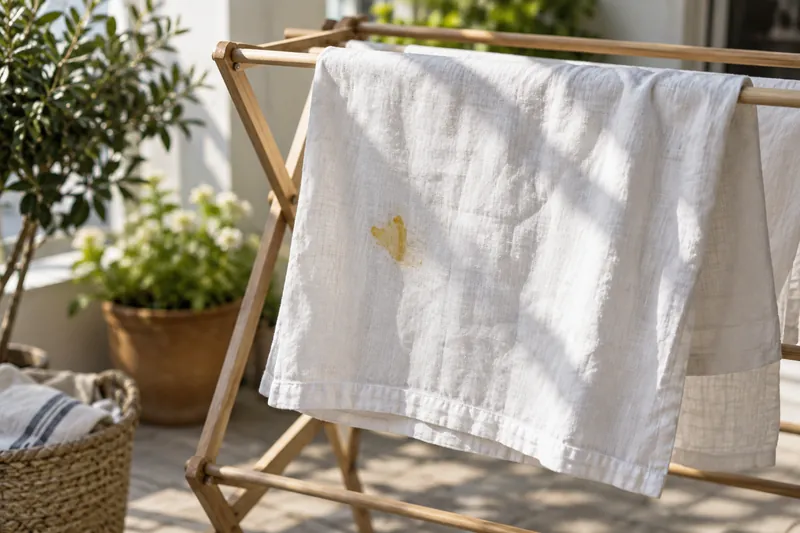
Turmeric and tomato stains can change appearance with light, but the garment’s own dye may also fade. First remove compatible washable residues using the care label and a suitable detergent. A stain that becomes less visible outdoors may still include oil that needs cleaning.
Why Turmeric Turns Blood-Red When You Scrub It With Soap
Few laundry moments cause faster panic than dropping yellow curry or golden turmeric latte onto a white cotton shirt, rubbing the spot with laundry detergent or baking soda paste, and watching the yellow stain instantly turn vivid crimson-red.
You have not permanently ruined the shirt; you have simply triggered a reversible acid-base keto-enol indicator shift in curcumin (C_{21H_{20O₆, diferuloylmethane), the primary diarylheptanoid pigment in Curcuma longa rhizomes.
The Keto-Enol Tautomerism of Curcumin
Curcumin consists of two aromatic o-methoxyphenol rings connected by a seven-carbon heptadiene chain containing an alpha,beta-unsaturated beta-diketone moiety.
- Below
pH 7.5(Neutral and Acidic Media): Curcumin exists predominantly in its hydrogen-bonded keto-enol form with fully protonated phenolic hydroxyl groups. In this neutral state, its conjugatedπ-electron system absorbs blue-violet light with an absorption maximum (λ_{max) at420–430 nm, reflecting bright canary yellow light to your eye. - Above
pH 7.8–8.5(Alkaline Detergent, Soap, or Baking Soda): When you apply alkaline laundry detergent (pH 8.5–10.0), bar soap (pH 9.5), or sodium carbonate/bicarbonate, the acidic enolic proton (pK_{a1 ≈ 7.8–8.3) and subsequently the phenolic protons (pK_{a2 ≈ 8.5–9.0,pK_{a3 ≈ 9.5–10.7) are stripped away. Deprotonation increases electron delocalization across the entire heptadiene bridge, shiftingλ_{maxbathochromically from425 nmout to467–520 nm(green light absorption), which makes the fabric appear intensely red-orange to brownish-crimson.
Immediate Reversal Check: If you dab a drop of white distilled vinegar (5\% acetic acid) or lemon juice onto that alarming red turmeric blotch, the curcumin molecule immediately re-protonates and turns right back to yellow!
Why Tomato Lycopene and Turmeric Resist Plain Water
Both turmeric curcumin and tomato lycopene (C_{40H_{56, the bright red carotenoid pigment in marinara sauce, ketchup, salsa, and watermelon) are lipophilic (water-insoluble, oil-soluble) chromophores:
- Curcumin has an octanol-water partition coefficient of
log P ≈ 3.29and a water solubility in neutral water of less than0.001 mg/mL(<1 ppm). In cooking, curcumin is almost always dissolved in hot triglycerides (ghee, coconut oil, or vegetable oil), which carries the pigment deep into the hydrophobic regions of polyester fibers or coats cotton yarns. - Lycopene is an acyclic tetraterpene hydrocarbon built entirely of carbon and hydrogen (
40carbons with 11 conjugated double bonds and 2 non-conjugated double bonds). With zero polar hydroxyl or carboxyl groups, lycopene has alog P > 11and is completely insoluble in water. Furthermore, cooking tomatoes in olive oil isomerizes all-trans-lycopene into cis-lycopene isomers, which dissolve into the lipid phase and bind tenaciously to synthetic polyester and nylon fabrics via van der Waals dispersion forces.
Because neither molecule dissolves in water, rinsing a fresh curry or marinara stain under cold tap water accomplishes nothing except solidifying the cooking oil carrier around the chromophore.
How Solar UV Photobleaching Destroys Both Chromophores
While curcumin and lycopene are stubborn to wash out intact, the very feature that gives them their intense color—their long, uninterrupted chain of alternating single and double carbon bonds (conjugated polyene / diarylheptanoid π-system)—is also their greatest chemical vulnerability when exposed to direct sunlight.
The Photochemical Cleavage Mechanism (320–450 nm)
When a damp garment stained with curcumin or lycopene is laid flat in direct outdoor sunlight, solar UVA (315–400 nm) and high-energy visible violet/blue (400–460 nm) photons match the exact π → π^* electronic absorption bands of both pigments (λ_{max = 425 nm for curcumin; λ_{max = 444, 470, 502 nm for lycopene):
- Triplet State Excitation & Singlet Oxygen (
^1O₂) Generation: Absorbing a420–470 nmphoton promotes the chromophore from its singlet ground state (S_0) to an excited singlet state (S_1), which undergoes intersystem crossing into a long-lived excited triplet state (T_1). When atmospheric ground-state triplet oxygen (^3O₂) collides with the excited pigment on the damp fabric surface, energy transfers to create highly reactive singlet oxygen (^1O₂) and superoxide radicals (O₂^{bullet -). - [2+2] Cycloaddition Across the Conjugated Bridge: Singlet oxygen attacks the central carbon-carbon double bonds (
C=C) of the heptadiene bridge in curcumin or the polyene chain in lycopene, forming unstable dioxetane intermediates that cleave spontaneously:- Curcumin (
21carbons) cleaves at the centralbeta-diketone bridge into small, water-soluble vanillin, ferulic acid, feruloyl methane, and 4-vinylguaiacol. Because none of these single-ring fragments possess a long conjugated bridge, their absorption bands drop below320 nm(into the invisible ultraviolet range)—making them completely colorless to the human eye! - Lycopene (
40carbons) undergoes oxidative cleavage into shorter apo-lycopenals and 2-methyl-2-hepten-6-one, disrupting the 11-double-bond conjugation required to absorb visible light and erasing the orange-red stain.
- Curcumin (
| Parameter | Turmeric (Curcumin) | Tomato / Marinara (Lycopene) |
|---|---|---|
| Chemical Formula & Class | C_{21H_{20O₆ (Diarylheptanoid polyphenol) |
C_{40H_{56 (Tetraterpene carotenoid hydrocarbon) |
Visible Absorption (λ_{max) |
420–430 nm (Yellow); 467–520 nm at pH > 8 (Red) |
444, 470, 502 nm (three-peak orange-red band) |
| Step 1 Solvent Pretreatment | 70\% Isopropyl alcohol + non-ionic dish soap + glycerin |
Non-ionic liquid detergent + lipase enzyme pre-wash |
| Optimal Solar UV Exposure | 2–4 hours damp in direct mid-day sun (white/light fabrics) |
2–5 hours damp in direct mid-day sun |
Step-by-Step Removal Protocol: Lipid Extraction First, Photons Second
Never put a curry- or marinara-stained garment straight into the sun while cooking oil is still saturating the weave, or UV radiation will cross-link the unsaturated cooking oil into a sticky varnish. Follow this exact two-phase sequence:
- Phase 1 — Extract the Carrier Oil and Free Pigment:
- Blot excess sauce off the fabric surface without rubbing.
- For turmeric, apply a few drops of 70% isopropyl alcohol (or hand sanitizer) mixed with a drop of clear dish soap to the back of the stain and blot onto a folded white paper towel underneath. The alcohol solubilizes the bulk curcumin while the dish surfactant emulsifies the cooking ghee/oil.
- Machine wash at
40 °C(104 °F) with a lipase/amylase enzyme detergent and30 gof sodium percarbonate. (Do not be alarmed when the sodium percarbonate turns the remaining trace turmeric stain pink/red during the wash—that simply confirms alkaline deprotonation.)
- Phase 2 — Damp Solar UVA/Blue Photobleaching:
- Remove the wet garment from the washer before tumble drying.
- Mist the pale yellow/pink ghost stain lightly with water (or water with
1\%hydrogen peroxide for white cotton) so the fiber remains damp—moisture accelerates singlet oxygen diffusion by3× to 4×compared to bone-dry cloth. - Lay the garment flat in direct outdoor sunlight (or on a sunny windowsill—since
400–460 nmviolet/blue light passes straight through standard window glass!) for1.5 to 4 hours. Note: on dark or brightly dyed garments, tent a folded white towel over the surrounding fabric so only the stained spot receives direct solar UV, preventing photofading of the garment’s background dye.
Review how conjugated pigments fit into the broader stain hierarchy in The Four Classes of Stains: Protein, Tannin, Oil & Dye Removal Chemistry, compare solar singlet-oxygen bleaching against chemical perhydroxyl oxidation in Sodium Percarbonate vs. Sodium Hypochlorite: Oxygen vs. Chlorine Bleach pH, and look up curry and tomato protocols in our Stain Chemistry × Textile Fiber Safety Lookup Matrix.
Practical check: what to observe
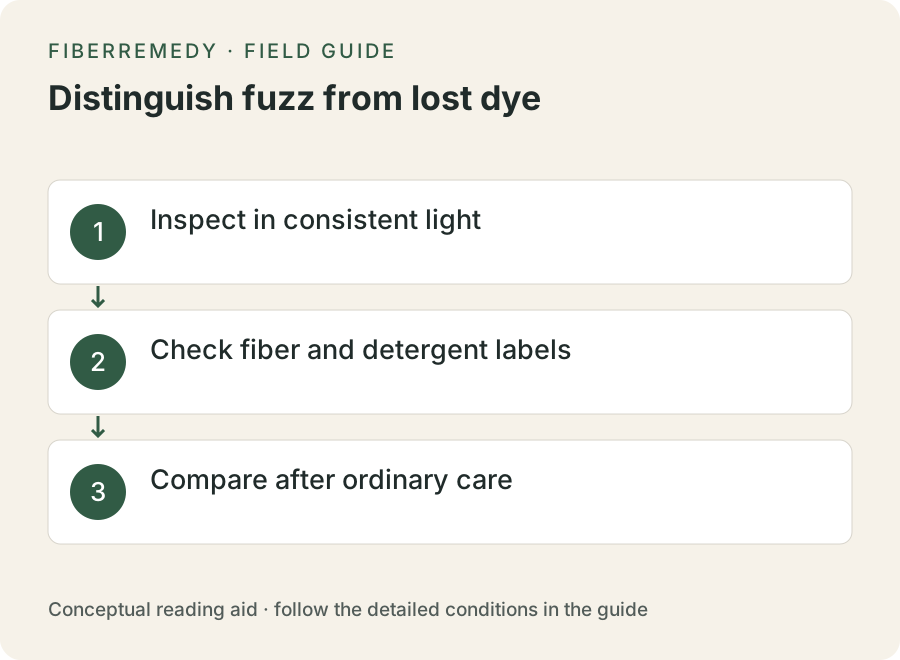
Compare dry fabric in consistent indoor light, not one wet sample with one dry sample. Protect delicate or valuable textiles from unnecessary exposure. If a visible outline remains, reassess the stain rather than extending sun exposure indefinitely.
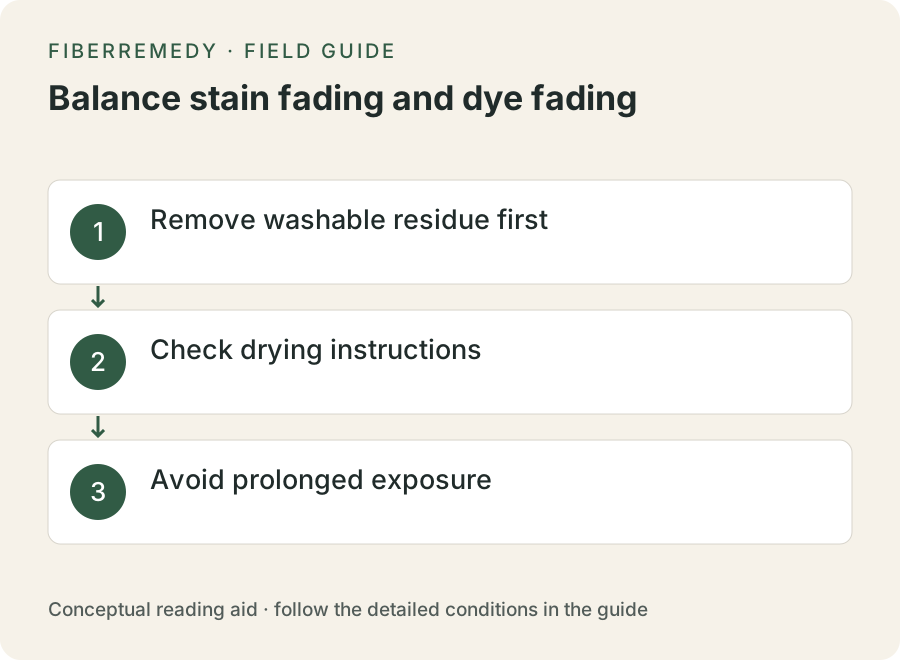
- Remove washable residue first
- Check drying instructions
- Avoid prolonged exposure
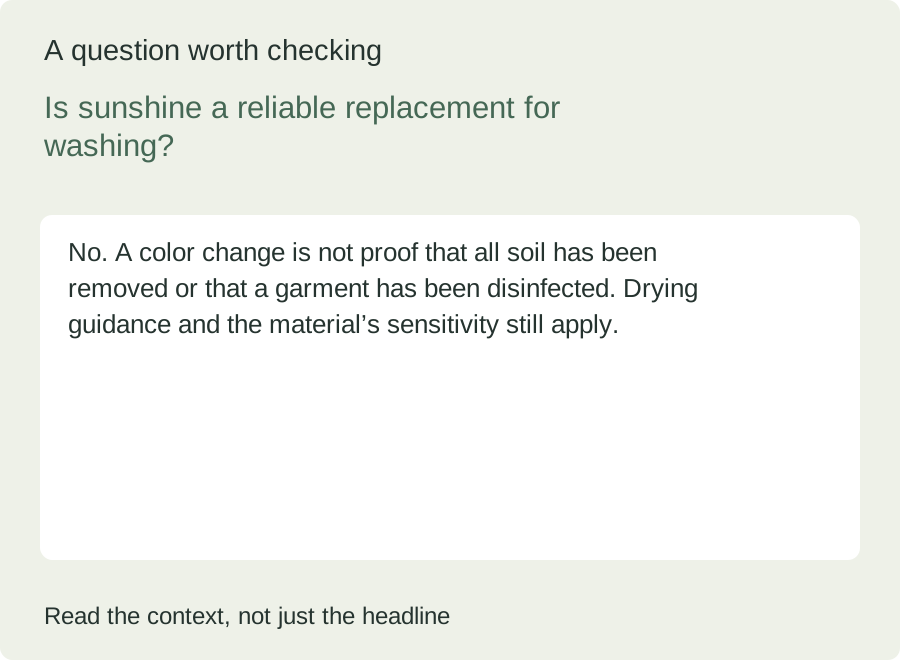
Is sunshine a reliable replacement for washing?
No. A color change is not proof that all soil has been removed or that a garment has been disinfected. Drying guidance and the material’s sensitivity still apply.
For more context, see the topic FAQ and glossary. A reference value or example should be read with its units, assumptions and product-specific conditions.
Sources and scope
The references below were supplied with the original manuscript. A reference is not evidence that every numerical claim has been independently checked. See the source library and our verification status.
- Tonnesen, H. H. et al. (1986) — Photochemical Stability of Curcumin: Identification of Photodegradation Products (Z. Lebensm. Unters. Forsch.)
- Priyadarsini, K. I. (2014) — The Chemistry of Curcumin: From Extraction to Therapeutic Agent and Photophysics (Molecules)
- Boon, C. S. et al. (2010) — Factors Influencing the Chemical Stability and Photodegradation of Carotenoids in Foods (Critical Reviews in Food Science)
Put the explanation to work
Continue reading
Spot a questionable claim or a calculation issue? Read our correction process and contact information. Examples and illustrations are educational; they do not establish product suitability or a laboratory result.